Rivermead Central

John R Smith

Western Thunderer
I have several left-hand ‘non-electric’ turnouts available, subject to repair and modification. That’s just a question of choosing a good one and spending the time on dismantling and rebuilding it. Unfortunately, I do not have a right-hand electric turnout. Ideally, I will find one. Until that happens, I have plenty else to be getting on with. Ultimately, if I still haven’t found one and not having the electric turnout becomes a block on making progress, I will scratch build one from Lowko Track components.

Martin

I have to say that I have found working within the constraints of fixed radii etc a real wake-up call. The last time that I used sectional track was on my Hornby Dublo layout in the 1950s. Since then I have become far too used to either slapping down some Peco Streamline, curving it too taste and chopping off a length (Gauges N and 00), or to building my own track on separate sleepers and crossing timbers (Gauges O and 1). Now, like you, I have to work within the confines of the set radii and geometry determined by Bassett-Lowke - in my case, post-war B-L Permanent Way, with 18 inch standard length straights and curves, two basic radius curves and turnouts (one of which is called 3 foot radius but isn't), and crossovers and parallel points which are 24 inches long. It all takes me back to the days of Hornby clockwork on the carpet, when it was always a puzzle to join up the two ends of an ambitious circuit around the sofa, past the cat and under the table - often aligning the rails involved a bit of cheating here and there!

John
 

40057

Western Thunderer
Martin

I have to say that I have found working within the constraints of fixed radii etc a real wake-up call. The last time that I used sectional track was on my Hornby Dublo layout in the 1950s. Since then I have become far too used to either slapping down some Peco Streamline, curving it too taste and chopping off a length (Gauges N and 00), or to building my own track on separate sleepers and crossing timbers (Gauges O and 1). Now, like you, I have to work within the confines of the set radii and geometry determined by Bassett-Lowke - in my case, post-war B-L Permanent Way, with 18 inch standard length straights and curves, two basic radius curves and turnouts (one of which is called 3 foot radius but isn't), and crossovers and parallel points which are 24 inches long. It all takes me back to the days of Hornby clockwork on the carpet, when it was always a puzzle to join up the two ends of an ambitious circuit around the sofa, past the cat and under the table - often aligning the rails involved a bit of cheating here and there!

John
Hi John

Certainly, working with sectional track and fixed sizes brings its own challenges. There are all sorts of devices that can help make the best use of space and deliver a reasonably prototypical track layout, but there are things that just can’t be done. The catalogue listings for Lowko Track (and Scale Permanent Way) do recognise this. There are the standard units, fine for a circle on the carpet with a few sidings, and there are the components sold for home construction. Using standard, factory made, Lowko Track 15” lengths of plain line saves a huge amount of work, and they are authentic period track. Building my own bespoke lengths from original components is also entirely in keeping with practice at the time.

Having now also decided to use post-WW2 Scale Permanent Way, for the yard at Cavendish Goods, I can make a direct comparison with Lowko Track. The shorter (15”) length of Lowko Track pieces is a huge advantage, allowing successive turnouts to be 3” closer together. The post-WW2 track just eats up space, even for a very simple arrangement. Of course, the Scale Permanent Way is much better engineered. I have to say, I am not looking forward to rebuilding at least another ten Lowko Track points. On the plus side, I like the period look of Lowko Track, the round-headed rails are kind to lead wheels, it’s the correct period for most of my rolling stock. Crucially too, for me, my base-boards were constructed based on Lowko Track geometry — straight lengths in multiples of 15”, curved sections to suit 3’ 2 1/4” radius track. I’m still going to have to cut up damaged track panels to make short lengths etc. — but use of Lowko Track was designed in before I built anything.

Martin
 

Allen M

Western Thunderer
It all takes me back to the days of Hornby clockwork on the carpet, when it was always a puzzle to join up the two ends of an ambitious circuit around the sofa, past the cat and under the table - often aligning the rails involved a bit of cheating here and there!

John

And running the trains :-
"It was at 9, No it was 8, it was on time, no it was late, alas I remember it well" ;)

Sorry I'l get my coat (but it did take me back well over 70 years when doing similar.):)

Regards
Allen
 
Last edited:

40057

Western Thunderer
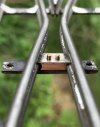
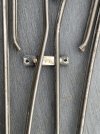
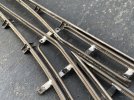
Continuing with rebuilding the right-hand Lowko Track turnout last reported on in my post #370.

I have now strengthened the fastenings at the crossing end of the switch-blades. A support between the switch blades to prevent any movement in that direction:

0382D1C0-BE5B-42B0-B121-3734C8418FD8.jpeg

A countersunk 10BA brass screw ‘outside’ each rail to hold them down and prevent outward movement:

9A7531F4-6955-4124-AF9B-04A5F4268C14.jpeg

Then remake the original soldered joints to hide the screw heads and neaten the fastenings for the central support by trimming the projecting ends of the screws and filing flush:

A3C300F2-2A10-46CF-AEC0-24F39BC02945.jpeg

Once the soldered joints are repainted black, the modifications to strengthen the fastenings will be invisible.

Nothing particularly difficult involved, just time consuming work drilling and tapping holes in the extremely hard steel used for the transverse metal strips to which the rails are soldered.
 

40057

Western Thunderer
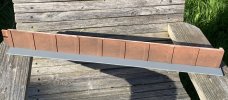
After a short break from modelling activity, work has resumed on the wall + yard office intended for the back of the layout immediately south of the Benham’s works.

I have mounted the wall on a plywood base painted to match the base-boards:

84E86B79-5088-488E-9048-66770C3F4C4B.jpeg

E4BE3932-4E03-4B17-8EC9-EE2FA8C06DEA.jpeg

The wall is fastened to the plywood strip by wood screws upwards into the wall. The whole structure will be held in place on the layout by wood screws down through the plywood strip (the four holes near the front). The ‘step up’ to the plywood strip from the base-board won’t show as it will be behind the track into the Benham’s siding. As well as enabling fixing the wall in place, the plywood strip should resist any attempt by the wall to warp, always a risk with a wood-based structure.
 

John R Smith

Western Thunderer
As your layout space is 23 feet long, does this mean that you have to construct 23 ' of backdrop (times two, perhaps)? Or is the 3D backdrop just limited to certain areas?

John
 

40057

Western Thunderer
As your layout space is 23 feet long, does this mean that you have to construct 23 ' of backdrop (times two, perhaps)? Or is the 3D backdrop just limited to certain areas?

John
Hi John

Yes, I’m afraid I have about 60’ of wall to cover along the back of the base-boards. When the current item under construction (wall + yard office) is finished and installed on the layout, about one third of the west wall will be covered (and none of the south, east and north walls). So it’s a huge task. However, most of the 60’ isn’t going to require anything as complicated as the Benham’s buildings. In some places, just a boundary wall will do. In the corners of the room, buildings in front may mean the back of the base-board is completely screened from view. If the ‘sky’ does remain visible right down to the base-board in some places, it won’t stop me running trains once the track is laid. I can return to covering the walls later.

Martin
 
Last edited:

40057

Western Thunderer
I referred above to a short break from doing any actual modelling. One reason was a visit to the North-west to see 828:

CC84A7DC-950B-4B6A-947D-F2E7A35C40A0.jpeg

Also, to discuss with Tom Mallard a future project.

828 is indeed wonderful but there is no point in repeating comments and information already posted in Tom Mallard’s workbench thread. What I would add is that the process of building a new clockwork model using a pre-WW1 motor is akin to experimental archeology — an approach to understanding how people did things in the past by trying to replicate what they did to see what works.

I have previously described the various 0 gauge scale-model tank engines designed by Henry Greenly, made by Bing and retailed by Bassett-Lowke in the years just before the First World War (see my post #92). There were also tank locos made in gauges 1 and 2, including prototypes not offered in 0 gauge. In the same range of models, in 0 gauge, there were five express locos made with clockwork or electric motors; a Midland Railway ‘999’, GWR ‘City’, LNWR ‘George the Fifth’ (also available as ‘Queen Mary’), Caledonian Railway ‘140 Class’ and GNR large-boilered Atlantic. Two further 0 gauge 4-4-0s were available, but in live-steam — Midland Railway ‘Compound’ no.1000 and LNWR ‘Jubilee’ no.1902 ‘Black Prince’. Most of the 0 gauge models were similarly made in Gauge 1, but not the GWR City and MR 999. In Gauge 1 only, the MR Compound no.1000 was produced in live-steam and clockwork versions. A live-steam version of the GNR Atlantic was offered in Gauge 1, also in live steam a Claughton, LTSR 4-4-2T and GWR ‘County’. Clockwork and electric models offered in the larger gauges (but not made in 0 gauge) included a GNR 0-6-2T, LNWR 4-6-2T, L&YR ‘Dreadnought’ and GCR ‘Sir Sam Fay’. One clockwork 0-6-0 tender loco was offered in 0 gauge (LNWR), two in Gauge 1 (LNWR and MR).

It’s easy to look at surviving examples of the models listed above and just admire the wonderful workmanship and artistic portrayal of the prototype. The models were necessarily simplified and lack many details, but generally capture the overall proportions and essential character of the real locomotive. Comparing these models with modern manufacture is perhaps like the difference between a painting of something and a photograph. What I have not previously understood well was how these Greenly designs managed to be so successful at capturing the look of the real locomotives. Which is where the experimental archeology comes in.

At a time before many homes had electricity, most model railways relied on clockwork for their operation. Fitting a clockwork motor with a large spring into a model locomotive is not easy. It was a huge challenge with 828. The spring has to fit in the space between the driving wheels and the top of the boiler/firebox. Prototypes with high-pitched, large-diameter boilers and/or Belpaire fireboxes are therefore preferable. Small-diameter driving wheels give more headroom above the axles for the spring. Side-tanks are good too because they disguise the lack of daylight under the boiler. For a planned future project, when trying to work out what would make a suitable prototype for a really powerful shunting locomotive, I ended up searching for something with all the ‘helpful’ characteristics just mentioned. The thought process of trying to work out how to accommodate A REALLY BIG SPRING in a realistic, accurately proportioned model highlighted that prototype selection was all-important. Once you start to think about how to build one, it is very clear that only some prototypes are suitable for a clockwork model.

Another difficulty with model railways in the pre-WW1 era was the extremely tight radius of curves then generally available. To be of any practical use, an 0 gauge model, for example, had to readily run on 2’ radius track. So the lateral displacement of bogies and pony trucks on model locomotives was enormously greater than in real life. Again, this requirement makes an accurately proportioned model an impossibility for many prototypes — for instance, many locomotives with leading bogies and outside cylinders and valve gear.

The design of 828, working out how to fit the motor into a previous ‘new build’ clockwork locomotive and planning for a future construction have all contributed to my understanding what makes a good prototype for a clockwork model. If I apply what I have learnt from those projects to the pre-WW1 range of locomotives sold by Bassett-Lowke, I think I can see a similar thought process at work. The models were good because the prototypes were chosen so the models could be good. With just three exceptions, all the clockwork/electric locomotives with leading bogies had inside cylinders — so the bogie wheels could be of close to scale diameter despite the requirement to traverse very small radius curves. The exception in 0 gauge — Ivatt Atlantic no.1442 — was a celebrity locomotive, the GNR royal train engine that was exhibited at the Imperial International Exhibition at White City in 1909; presumably, the commercial desirability of offering a model of this engine outweighed the compromises required to produce a working model. In Gauge 1, the only outside cylinder model made just in clockwork was the L&YR Dreadnought. By contrast, out of practical necessity, all of the live-steam models were of prototypes with two outside cylinders. For these models, to be useable on tinplate track, the bogie wheels were unavoidably under-size. Bassett-Lowke acknowledged this in catalogue descriptions and could supply scale-sized bogie wheels in Gauge 1 for customers using only larger radius curves. Of course, starting with the 0 gauge ‘Royal Scot’ in 1929 and through the 1930s, when outside cylinders and generally outside valve gear became the norm for large, modern express locomotives, Bassett-Lowke sold many models with undersized wheels on the leading bogie. But pre-WW1, when modern express locomotives could have either inside or outside cylinders, Bassett-Lowke (or perhaps Henry Greenly) chose types with inside cylinders for their clockwork/electric models with leading bogies, types with outside cylinders generally only for live-steam models. With the benefit of having had to puzzle about how I could potentially fit a clockwork motor into various possible prototypes, I think I can see that the same considerations contributed to the choices made by Bassett-Lowke pre-WW1. Sure, models had to sell, so they had to be up-to-date and be of prototypes belonging to major railway companies, but they also had to have enough room in the boiler/firebox for the motor. Of the 0 gauge express locomotives offered, two had Belpaire fire-boxes, the other three had large diameter (for the time), high-pitched boilers.

Maybe I have been rather slow here and should have realised sooner just how much careful thought was given to prototype selection for the range of Greenly-designed locomotives Bing made for Bassett-Lowke. For me, understanding has come from the process of trying to work out for myself how to make an accurately proportioned clockwork model to run on tinplate track. A realisation that when I was dismissing potential prototypes as unsuitable, because a realistic model was not possible due, for example, to insufficient room for the spring in the small boiler, or the track curvature, this had been done before. A similar process of choosing what to make, for the same reasons, must have taken place at Bassett-Lowke’s when their pre-WW1 range of scale model-railway locomotives was decided.

 
Last edited:

timbowales

Western Thunderer
I referred above to a short break from doing any actual modelling. One reason was a visit to the North-west to see 828:

View attachment 240142

Also, to discuss with Tom Mallard a future project.

828 is indeed wonderful but there is no point in repeating comments and information already posted in Tom Mallard’s workbench thread. What I would add is that the process of building a new clockwork model using a pre-WW1 motor is akin to experimental archeology — an approach to understanding how people did things in the past by trying to replicate what they did to see what works.

I have previously described the various 0 gauge scale-model tank engines designed by Henry Greenly, made by Bing and retailed by Bassett-Lowke in the years just before the First World War (see my post #92). There were also tank locos made in gauges 1 and 2, including prototypes not offered in 0 gauge. In the same range of models, in 0 gauge, there were five express locos made with clockwork or electric motors; a Midland Railway ‘999’, GWR ‘City’, LNWR ‘George the Fifth’ (also available as ‘Queen Mary’), Caledonian Railway ‘140 Class’ and GNR large-boilered Atlantic. Two further 0 gauge 4-4-0s were available, but in live-steam — Midland Railway ‘Compound’ no.1000 and LNWR ‘Jubilee’ no.1902 ‘Black Prince’. Most of the 0 gauge models were similarly made in Gauge 1, but not the GWR City and MR 999. In Gauge 1 only, the MR Compound no.1000 was produced in live-steam and clockwork versions. A live-steam version of the GNR Atlantic was offered in Gauge 1, also in live steam a Claughton, LTSR 4-4-2T and GWR ‘County’. Clockwork and electric models offered in the larger gauges (but not made in 0 gauge) included a GNR 0-6-2T, LNWR 4-6-2T, L&YR ‘Dreadnought’ and GCR ‘Sir Sam Fay’. One clockwork 0-6-0 tender loco was offered in 0 gauge (LNWR), two in Gauge 1 (LNWR and MR).

It’s easy to look at surviving examples of the models listed above and just admire the wonderful workmanship and artistic portrayal of the prototype. The models were necessarily simplified and lack many details, but generally capture the overall proportions and essential character of the real locomotive. Comparing these models with modern manufacture is perhaps like the difference between a painting of something and a photograph. What I have not previously understood well was how these Greenly designs managed to be so successful at capturing the look of the real locomotives. Which is where the experimental archeology comes in.

At a time before many homes had electricity, most model railways relied on clockwork for their operation. Fitting a clockwork motor with a large spring into a model locomotive is not easy. It was a huge challenge with 828. The spring has to fit in the space between the driving wheels and the top of the boiler/firebox. Prototypes with high-pitched, large-diameter boilers and/or Belpaire fireboxes are therefore preferable. Small-diameter driving wheels give more headroom above the axles for the spring. Side-tanks are good too because they disguise the lack of daylight under the boiler. For a planned future project, when trying to work out what would make a suitable prototype for a really powerful shunting locomotive, I ended up searching for something with all the ‘helpful’ characteristics just mentioned. The thought process of trying to work out how to accommodate A REALLY BIG SPRING in a realistic, accurately proportioned model highlighted that prototype selection was all-important. Once you start to think about how to build one, it is very clear that only some prototypes are suitable for a clockwork model.

Another difficulty with model railways in the pre-WW1 era was the extremely tight radius of curves then generally available. To be of any practical use, an 0 gauge model, for example, had to readily run on 2’ radius track. So the lateral displacement of bogies and pony trucks on model locomotives was enormously greater than in real life. Again, this requirement makes an accurately proportioned model an impossibility for many prototypes — for instance, many locomotives with leading bogies and outside cylinders and valve gear.

The design of 828, working out how to fit the motor into a previous ‘new build’ clockwork locomotive and planning for a future construction have all contributed to my understanding what makes a good prototype for a clockwork model. If I apply what I have learnt from those projects to the pre-WW1 range of locomotives sold by Bassett-Lowke, I think I can see a similar thought process at work. The models were good because the prototypes were chosen so the models could be good. With just two exceptions, all the clockwork/electric locomotives with leading bogies had inside cylinders — so the bogie wheels could be of close to scale diameter despite the requirement to traverse very small radius curves. The exception in 0 gauge — Ivatt Atlantic no.1442 — was a celebrity locomotive, the GNR royal train engine that was exhibited at the Imperial International Exhibition at White City in 1909; presumably, the commercial desirability of offering a model of this engine outweighed the compromises required to produce a working model. By contrast, out of practical necessity, all of the live-steam models were of prototypes with two outside cylinders. For these models, to be useable on tinplate track, the bogie wheels were unavoidably under-size. Bassett-Lowke acknowledged this in catalogue descriptions and could supply scale-sized bogie wheels in Gauge 1 for customers using only larger radius curves. Of course, starting with the 0 gauge ‘Royal Scot’ in 1929 and through the 1930s, when outside cylinders and generally outside valve gear became the norm for large, modern express locomotives, Bassett-Lowke sold many models with undersized wheels on the leading bogie. But pre-WW1, when modern express locomotives could have either inside or outside cylinders, Bassett-Lowke (or perhaps Henry Greenly) chose types with inside cylinders for their clockwork/electric models with leading bogies, types with outside cylinders generally only for live-steam models. With the benefit of having had to puzzle about how I could potentially fit a clockwork motor into various possible prototypes, I think I can see that the same considerations contributed to the choices made by Bassett-Lowke pre-WW1. Sure, models had to sell, so they had to be up-to-date and be of prototypes belonging to major railway companies, but they also had to have enough room in the boiler/firebox for the motor. Of the 0 gauge express locomotives offered, two had Belpaire fire-boxes, the other three had large diameter (for the time), high-pitched boilers.

Maybe I have been rather slow here and should have realised sooner just how much careful thought was given to prototype selection for the range of Greenly-designed locomotives Bing made for Bassett-Lowke. For me, understanding has come from the process of trying to work out for myself how to make an accurately proportioned clockwork model to run on tinplate track. A realisation that when I was dismissing potential prototypes as unsuitable, because a realistic model was not possible due, for example, to insufficient room for the spring in the small boiler, or the track curvature, this had been done before. A similar process of choosing what to make, for the same reasons, must have taken place at Bassett-Lowke’s when their pre-WW1 range of scale model-railway locomotives was decided.
What an absolutely wonderful piece of research
 

John R Smith

Western Thunderer
Martin

What a well researched and presented overview of the principles behind Greenly and Bassett-Lowke's design criteria for the smaller gauges prior to 1914. I am sure that you have seen them, but I am reminded of Norman Eagles' series of articles in the MRN detailing his locomotive designs for the Sherwood Section - all clockwork and custom built (many by Leslie Forrest) using commercial mechanisms in creative ways to fit into quite small prototypes. This was in many ways the last hurrah of serious clockwork model making - until now, when it seems that you have picked up the baton and run with it!

John
 
Last edited:

40057

Western Thunderer
Some inevitable slowing of modelling progress with the good weather, vigorous growth of weeds in the garden etc. etc.

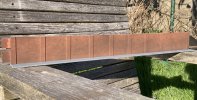
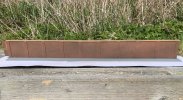
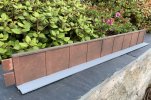
Nevertheless, coping fixed and painted on the section of boundary wall for the back of the layout south of the Benham’s works:

C66C7E65-B3E4-48FB-A965-3197C4A1B090.jpeg

F81A1E2B-7D06-41DD-ABF5-9AF0EA52268D.jpeg

I have given this a light spray coat of matt varnish. I will brush on some more weathering on top of the coping and some patchy staining on the brickwork below the coping.
 

40057

Western Thunderer
Signalling advice — please!

And thank you in advance for any assistance given.

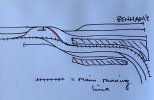
I am not sure how the north-facing exit from the goods sidings at Cairnie Junction should be signalled.

This is the track layout:

67AF6996-7991-4AFA-9623-D686050B34EC.jpeg

All the tracks ‘above’ (= west of) the main running line are in the yard. So no signalling required, yard working. The exit track from the yard is highlighted in red. The signal for leaving the yard north-bound has to be before the points leading to the sidings between platform 1 and the Benham’s works, as these points are the trap protecting the main line. But a signal in this position will be ‘passed at danger’ all the time during shunting. Does that matter, as the signal refers only to the diverging track? Or would the signal have an arrow or ‘M’ or similar on the post, for example, identifying that it refers to the track leading to the main line? I’m really not sure what prototype practice would be in a similar situation.

Any signal really ought to have a calling on arm but I may have to forget about that. Would a shunt signal at the base of the post be an acceptable alternative for letting something into platform 1 (e.g. to attach a van to the back of a passenger train, a loco to pull out coaches and put them in the centre road)?

Any advice would be most welcome!
 

John R Smith

Western Thunderer
Martin

I'm a bit confused by your diagram. To clarify, is your main running line one directional or bi-directional? And apart from the line marked in red, there would appear to be another exit from the yard to the main south bound.

John
 

40057

Western Thunderer
Martin

I'm a bit confused by your diagram. To clarify, is your main running line one directional or bi-directional? And apart from the line marked in red, there would appear to be another exit from the yard to the main south bound.

John
Hi John

Sorry if it’s not clear.

The main running line is bi-directional.

The south-facing exit is different in that the two tracks from the ‘last point’ lead to the main line or the Cavendish Goods branch — so a splitting signal will be required.

Martin
 

John R Smith

Western Thunderer
Martin

I assume the "yard" consists of the three sidings at the NW of the plan, one of these being Benhams. How do trains normally enter the yard - from the North or from the South? If from the S, how do they run round the train? Is the line at the top of the plan to the S a headshunt?

Normally, you would never site a semaphore signal so that it had to be passed at danger in the course of normal repeated shunting moves. If this was an occasional requirement, then you would have a shunt ahead arm below the primary aspect. In this instance, a more elegant solution (if you absolutely have to exit the yard from the N) would be to have a disc ground signal to control the first lead, and a semaphore separately just by the junction with the main. The disc signal would then have a yellow band rather than a red, which allows it to be passed at danger in the direction which it does not control.

Situations like this are tricky in full size practice. Normally one tries very hard to avoid fouling running lines in the course of shunting, but sometimes this is unavoidable as at Kingsbridge my hometown station. There the headshunt from the yard was very short, forcing certain moves to take place onto the main under the control of a shunt ahead signal below the outer advanced starter.

At Newton Abbot when I was working there as a shunter in the down side yard, we used to have to once a day make a trip up the Heathfield Branch. This involved getting permission from the signalman to exit the yard via a semaphore controlling the connection to the down main, run over to the up main on a facing crossover (controlled by a disc), and then take a left turn to the branch via a splitting junction signal. I used be there on the 'phone getting permission for all this, and of course we would be kept waiting for ages until there was a clear path. It was good fun though, banging and rattling up the branch in the cab of the 08.

John
 

40057

Western Thunderer
Hi John

Ahh … the Heathfield branch (as it became). Used by my mother to get from Chudleigh Knighton (where she lived) to school in Newton Abbot (Newton Abbot Grammer School), changing at Heathfield.

I expect goods trains to enter and exit the yard using both the north and south facing connections to the main. Trains will depart to distant places in one direction — and return soon afterwards (having run round my circuit) using the other access. I wanted accesses facing both ways to reduce the need to propel whole trains on the main line.

The ‘yard’ is indeed the three sidings in the NW. Yes, ‘yard’ is a bit grandiose. But it’s in the tinplate tradition of ‘King’s Cross to York’ — on the living room floor. Scaled up, Cairnie Junction would be a tiny little place. On my railway, it’s an important and busy station. By the same token, I’m intentionally trying to give buildings that are actually small features IRL typically associated with much larger and more important buildings — for example the roof sign on the Benham’s factory.

You are also correct that the topmost line heading south is the yard headshunt. I may make it a loop by putting in another turnout connecting to the line to Cavendish Goods (the middle line heading south). A loop would be better but that requires me to rebuild yet another Lowko Track point, and I’m not sure how many rebuilds I can face. Similarly, I have decided to dispense with trap points. Too much work and no siding to show for it. I will use headshunts and similar to protect running lines where I can — but trap points leading to nothing? Sorry, no, not putting in those.

Thank you very much for your expert advice. A ground signal with a semaphore just before the junction with the main makes perfect sense. The constraints of using vintage commercial equipment come into play here though — I doubt if ground signals with a yellow band were ever made. My achievable compromise might be a point indicator lamp followed by a semaphore just before the junction. I know I am going to have to accept incomplete signalling because of what vintage equipment was made and what I can find. I do have some unused original Bassett-Lowke signal parts, so I could make some bespoke signals correct for particular locations. But adding that to the huge list of things to do — where will I find the time?

I will try and avoid inappropriate signalling, but I will have to live with incomplete signalling.

Thank you again for your very helpful explanations.

Martin
 

40057

Western Thunderer
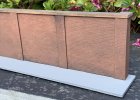
I have finished the section of wall destined for the back of the layout south of the Benham’s works. I won’t be installing this on the layout until the yard office is also complete and joined to the south end of the wall.

The whole section of wall:

22F23144-4172-4674-996C-DCFDFC67BAE6.jpeg

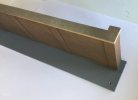
The two projecting ends of the plywood strips that make up the core of the wall will provide the means of attaching the yard office building.

The additional weathering added since the previous photographs can be seen here:

823A3CC6-C33E-464F-82FD-C85518FE9F57.jpeg

0ADE8671-AEE6-4932-BEFA-9361826FCDF3.jpeg
 

40057

Western Thunderer
Let me introduce you to Frank:

22DD95AB-1849-4CEE-87DA-2570D022AEC2.jpeg

If my memory is right, Frank was the first vintage 0 gauge figure I obtained. He’s certainly been with me more than fifty years.

Frank has had an exceptionally long career as a railway porter starting in the early 1930s. He was one of six — from ‘Modelled Miniatures’ set no.1 ‘Station Staff’ produced by Meccano Ltd to go with Hornby 0 gauge trains. Frank’s base was originally a bright orange, but someone (not me) has over-painted it in grey. Rather helpful in terms of placing Frank on my layout.

I have mentioned before that some items from the Hornby range — intended primarily as toys for children — do sit comfortably with scale model trains of the period. The passenger and staff figures produced by Meccano are particularly useful and easily as good, or better, than some produced by other manufacturers. Frank will have a place on Rivermead Central as long as the railway exists.

However, the reason for introducing you to Frank now is his new role. It occurred to me I need a ‘scale object’ to include in the photographs of some vintage items where what is represented varies in size. I have appointed Frank to this position.

Frank himself is 40 mm tall, nearer 42 mm including the base. Of course, he’s wearing a cap and not standing upright. His actual height won’t be far off 6’.

I should add that the later Meccano figures were smaller and much more crudely finished (e.g. eyes and mouth not painted in). Nowhere near as good as Frank and the figures produced when the range was first introduced.
 

40057

Western Thunderer
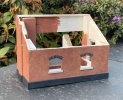
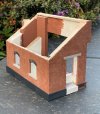
Very much a ‘work in progress’ — but there definitely is some progress. Having finished the wall element of the current build (see above), I have returned to the yard office building. All the brickwork is now in place except the chimney stack (ie. the bit above roof height):

0563E975-9D39-4D56-B5D2-CE3B547895CC.jpeg

B3C31FC1-500B-4D40-965F-B8D85A6D0FF5.jpeg

The ‘missing’ brickwork to the right of the doorway is where the office fits onto the wall section.

The window sills are on. The painting and weathering of the walls is still far from finished. I think I need to tone down the contrast between the engineering bricks and the red bricks. Windows, door, roof and chimney still to be made.
 
Top