Rivermead Central

Roger Pound

Western Thunderer
Seeing Frank reminded me of a figure I had for some years as a "young'un2 with a Hornby Clockwork set. This was a Woman with a small child being held by the hand. The woman was dressed in a gren coat with, I believe, a representation of a fur collar. I cammpot recall how the child was decorated, but I believe these were of Meccano origin. They disappeared in to history long ago. Perhaps you can confirm or correct this rather hazy memory from a time now too long past.....:(?

Roger.
 

40057

Western Thunderer
Seeing Frank reminded me of a figure I had for some years as a "young'un2 with a Hornby Clockwork set. This was a Woman with a small child being held by the hand. The woman was dressed in a gren coat with, I believe, a representation of a fur collar. I cammpot recall how the child was decorated, but I believe these were of Meccano origin. They disappeared in to history long ago. Perhaps you can confirm or correct this rather hazy memory from a time now too long past.....:(?

Roger.
Your memory is very good, Roger.

The figures you recall, made by Meccano:

F5A9DDD2-CD26-4022-8D11-3DD652D7346B.jpeg

I think the colour scheme used varied over time.
 

John R Smith

Western Thunderer
Perhaps you can confirm or correct this rather hazy memory from a time now too long past.....:(?

The woman with the child was indeed a staple of the Hornby/Dinky figure range. It also appears in various copies and variations, usually the child is on the left of the woman. At the latest count I have four examples in my collection, one with the child on the right. Here is the platform at Kingswell Street, with a group of good ladies waiting for the 10.15 am all stations to Worcester -

Passengers for Worcs Web.jpg

We can see the lady with the green coat, 2nd from the right. I think this one is a copy, because unlike the genuine Meccano Ltd figures it is not hollow cast. The van by the stops is off the 9.05 parcels, and will be attached to the Worcester train.

John
 

Roger Pound

Western Thunderer
My sincere thanks, gentlemen - I remember that the fur collar/scarf on the figure I had was a fawn colour, and green was the predominant shade used overall. Definitely a twin to the one featured in #402 :thumbs:. I am indeed obliged.

R.oger.
 

40057

Western Thunderer
A job for Frank in his new role.

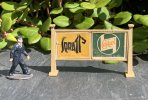
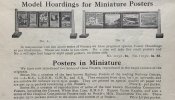
Advertising hoardings. Such a prominent feature in the urban and railway scene — so very necessary on the model railway.

First, here is the version made by Meccano Ltd for use with Hornby trains. One size, suitable for 0 and 00 gauges:

FE9A2701-8FD3-4D3E-9019-A6BFE63DE9C0.jpeg

It’s a painted alloy casting with paper posters, made after WW2. The posters look to have suffered from too much sunlight, especially, as usual, the red has faded. But a perfectly useable item. Another Hornby accessory completely suitable for use on Rivermead Central.

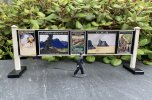
And now the Bassett-Lowke version:

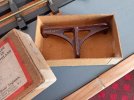
C69DE60C-0AE7-4ADC-81AC-403AADC24BC1.jpeg

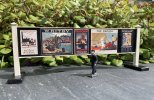
The other side:

DBAB747D-8BB9-43E4-A7CD-452047B86655.jpeg

Hand-built in wood, fastened together with moulding pins, painted and varnished. The caps on the posts are metal castings, the posters printed paper. Two lengths were made but otherwise all one size for use with gauges 0/1/2.

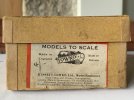
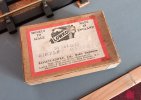
I have the original box for the above hoarding:

C0B98366-720C-4C06-A2CE-AE68EB8D43BF.jpeg

We can get a date of manufacture from the label; the Manchester shop opened in 1927, the Edinburgh shop was sold in 1930. Stamped on the label under the ‘Lowko’ logo, but very faded, it says ‘POSTER HOARDING’. Equally faded under ‘Size or Gauge’ is ‘1103/2’. This is the catalogue number:

753A212F-B1AC-4EFF-BC47-B85CE0DE4310.jpeg

Judging by the near-perfect condition of the hoarding I have, it must have spent nearly 100 years sat in its box.
 

John R Smith

Western Thunderer
Martin

That is a really nice hoarding. I have a full packet of the Series No 1 Posters, but no hoarding to mount them on!

Having the box is a real bonus - I have a nice pre-war one for this Simplex track gauge -

Simplex Gauge 02 Web.jpg

My box is later than yours, though, because there is no mention of the Edinburgh shop -

Simplex Gauge 01 Web.jpg

The track gauge is a bit of a cumbersome device I have to admit. The later brass version is a lot easier to use!

John
 

40057

Western Thunderer
I really must stop buying wagons. I already have enough and more awaiting repair than I have time to restore.

The trouble is …

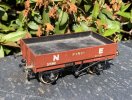
This ‘kit-built wagon’ was offered last week on a well-known internet auction site for less than £12:

2CCE5143-B6D9-4ACB-B973-D459919F5825.jpeg

It’s not ‘kit-built’ and technically, I guess, not a wagon, but NPCCS.

Without doubt, this beautifully made fish truck is the work of A.W.H. Pealling, a renowned builder of rolling stock in the 1930s—50s period (see my post #57, a Pealling mineral wagon).

OK, it’s not like discovering a Titian at a car boot, but it’s a good find and deserves to be recognised for what it is and restored. Which, somehow, I will now need to find the time to do.

It only arrived with me in the post this morning. A quick examination confirmed the identity of the builder — the unmistakeable brake gear made of card, the sides of laminated card — everything you would expect.

My examination also showed two broken push rods with brake shoes missing, some dodgy paint repairs and non-original buffers (there is evidence in the the paint work of buffer housings of larger diameter). At some stage, the buffers now present had a wire soldered between them for coupling purposes. One wheel is badly out of true and I’m not sure the 3-hole disc wheels (Bond’s?) are original either. The truck is very dirty.

Nothing impossible, but quite a list of work needed, which will all take time to do properly.

 

40057

Western Thunderer
I really must stop buying wagons. I already have enough and more awaiting repair than I have time to restore.

The trouble is …

This ‘kit-built wagon’ was offered last week on a well-known internet auction site for less than £12:

View attachment 241329

It’s not ‘kit-built’ and technically, I guess, not a wagon, but NPCCS.

Without doubt, this beautifully made fish truck is the work of A.W.H. Pealling, a renowned builder of rolling stock in the 1930s—50s period (see my post #57, a Pealling mineral wagon).

OK, it’s not like discovering a Titian at a car boot, but it’s a good find and deserves to be recognised for what it is and restored. Which, somehow, I will now need to find the time to do.

It only arrived with me in the post this morning. A quick examination confirmed the identity of the builder — the unmistakeable brake gear made of card, the sides of laminated card — everything you would expect.

My examination also showed two broken push rods with brake shoes missing, some dodgy paint repairs and non-original buffers (there is evidence in the the paint work of buffer housings of larger diameter). At some stage, the buffers now present had a wire soldered between them for coupling purposes. One wheel is badly out of true and I’m not sure the 3-hole disc wheels (Bond’s?) are original either. The truck is very dirty.

Nothing impossible, but quite a list of work needed, which will all take time to do properly.
By way of a PS, please can anyone explain why there is one running number painted on the body and a different one on the cast plate? The plate is undoubtedly Pealling’s work, the number on the body not up to his usual standard, but I can’t see any signs of alteration of overpainting.
 

John R Smith

Western Thunderer
please can anyone explain why there is one running number painted on the body and a different one on the cast plate

Certainly, the number 16860 on the body is not of the same quality as the NE, FISH, and 3 TONS. The tare, 5-7-0 is not so great either. So I would suspect that the wagon did not have its running number painted on the body as originally built, and a later owner added it. Why in heaven's name that person should have chosen a different number from that on the plate, I cannot imagine - unless they mistakenly thought the plate was a builders plate, and a build number.

My best guess!

John
 

40057

Western Thunderer
Certainly, the number 16860 on the body is not of the same quality as the NE, FISH, and 3 TONS. The tare, 5-7-0 is not so great either. So I would suspect that the wagon did not have its running number painted on the body as originally built, and a later owner added it. Why in heaven's name that person should have chosen a different number from that on the plate, I cannot imagine - unless they mistakenly thought the plate was a builders plate, and a build number.

My best guess!

John
John

The ‘NE’, ‘FISH’ and ‘3 TONS’ are transfers. But compare the hand lettering with my Stephenson Clarke wagon in post #57. Nowhere near as good.

Martin
 

John R Smith

Western Thunderer
The ‘NE’, ‘FISH’ and ‘3 TONS’ are transfers.

Martin

I bow to your judgement, but they don't (to my eyes) look crisp enough to be transfers. Are you sure that they are not handpainted characterss which have been spot over-varnished, giving the impression of a carrier film?

John
 

40057

Western Thunderer
Martin

I bow to your judgement, but they don't (to my eyes) look crisp enough to be transfers. Are you sure that they are not handpainted characterss which have been spot over-varnished, giving the impression of a carrier film?

John
No, I can’t be 100% certain. They appear to be transfers. The other (obviously hand painted) letting doesn’t have a similar patch of carrier film or varnish. None of the lettering on the SC wagon is over-varnished.

I think transfers.
 

Fitzroy

Western Thunderer
Bear in mind transfer artwork would have been done by hand and not at any particularly great magnification. So it’s not at all odd that it looks hand done.
 

John R Smith

Western Thunderer
Martin

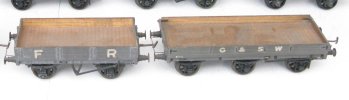
Here is a photo of some O Gauge wagons found on the Internet, which have numberplates like yours but no painted numbers on the body -

Mystery Wagons 01.jpg

Do they look familiar to you? I would guess that they are somewhere in the 1930s to 1950s time scale.

John
 

John R Smith

Western Thunderer
I don’t know who made those. Not Pealling, I’m sure.

This is the problem Martin, isn't it - provenance. I have now, like you, accumulated quite a collection of wagons, I suppose because I find it hard to resist them especially if they are cheap. The tinplate ones are pretty straightforward, especially the later Bassett-Lowke examples. Bing too usually have a GBN or the Bing Werke stamp, Carette are a bit more tricky but the couplings and style are distinctive.

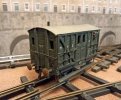
However, more recently I have focused on wooden wagons and most of the ones I have are mysterious creatures. One is I am sure Milbro, even though there is no trademark. Another has a very neat paper label underneath with the builder's name (if only they all did!), and with your help I now know that one of my vans is from Windsor Models. The rest have no history. I could not pass by this charming if somewhat robust version of a Maryport and Carlisle brake van just recently -

M&C BV 01 Web.jpg

But there is absolutely no indication on it of a maker (perhaps because the builder did not wish to accept the blame). And quite what an M&C van is doing on my West Country layout I have no idea!

Still, the quest goes on . . .

John
 

40057

Western Thunderer
This is the problem Martin, isn't it - provenance. I have now, like you, accumulated quite a collection of wagons, I suppose because I find it hard to resist them especially if they are cheap. The tinplate ones are pretty straightforward, especially the later Bassett-Lowke examples. Bing too usually have a GBN or the Bing Werke stamp, Carette are a bit more tricky but the couplings and style are distinctive.

However, more recently I have focused on wooden wagons and most of the ones I have are mysterious creatures. One is I am sure Milbro, even though there is no trademark. Another has a very neat paper label underneath with the builder's name (if only they all did!), and with your help I now know that one of my vans is from Windsor Models. The rest have no history. I could not pass by this charming if somewhat robust version of a Maryport and Carlisle brake van just recently -

View attachment 241464

But there is absolutely no indication on it of a maker (perhaps because the builder did not wish to accept the blame). And quite what an M&C van is doing on my West Country layout I have no idea!

Still, the quest goes on . . .

John
Hi John

Many (most?) Milbro wagons don’t have a trade mark. But it’s a catalogued range, using standard parts and construction techniques. There are non-standard and special order Milbro wagons out there, but generally still obviously Milbro.

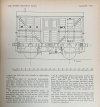
Regarding your M&C brake van, I would say ‘good amateur’ rather than a professional build. I will suggest a date of mid 1950s, because I bet it was made based on this article in the MRN:

907ABD97-EC32-4751-83B9-9F03F5B1E198.jpeg

F2F41FD6-1D14-4E5C-83F0-A18DD5439C1C.jpeg

4D88581C-D87C-427E-AB76-3026D3CF844E.jpeg

Martin
 

John R Smith

Western Thunderer
I will suggest a date of mid 1950s, because I bet it was made based on this article in the MRN:

Martin, I must congratulate you both on your archive of historical MRNs, and also remembering where to look!

That article has to be the inspiration for my brake van, I am sure.

Many thanks

John
 
Top