7mm Rob's Rolling Stock Workbench

Rob Pulham

Western Thunderer
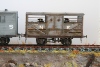
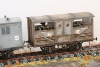
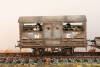
While I have been steadily working on Nellie (not much progress this week due to being worn out and not having the patience) , Chris has been weaving her magic on the Connoisseur Implement wagon.

ImplementWagon002-1.jpg

ImplementWagon003-1.jpg

ImplementWagon004.jpg

ImplementWagon005.jpg

ImplementWagon006.jpg

ImplementWagon007.jpg

And last but not least I did this earlier today - I have an almost complete Parkside LMS Brake van on the go. And while I built most of it at the cottage I brought it home to solder some of the brake fittings together.

While rummaging in a drawer for the backhead for Nellie I remembered that I had bought aa few cast brake van stoves from Slaters at one of the shows. So I got one out, soldered some copper tube in for the chimney and then gave it a good clean with shiny sinks. Then I immersed it in Carrs brass black.

Once I had rinsed it to stop the reaction I dryed and rubbed it with some paper towl resulting in this:
ImplementWagon001.jpg

Which to my mind gives a great representation of the black lead that my mother used to use on our cast stove when I lived at home.
 

Wagonman

Western Thunderer
Very tasty Rob (and Chris). Just one cavil – those cattle are very loosely packed and are likely to suffer injury whenever the train jolts. by the way, were there any Friesians here by the 1930s? I thought they didn't start arriving until the 1950s... :)


Farmer Giles
 

Buckjumper

Flying Squad
Friesians were first imported to the UK in large numbers from Holland until 1892 when there was a freeze on imports to protect against a huge Foot & Mouth outbreak on the continent. For a decade numbers dwindled so far that the breed wasn't included in the 1908 census. In 1909 what was to become the British Frisian Cattle Society was formed. By 1912 1000 males and 6000 females were listed, and the import ban was lifted in 1914 with an official importation. In 1922 another importation occurred from South Africa, and a further one in 1936, again from Holland. After the war, there was indeed an expansion which lasted through the 80s, but it is perfectly proper to have Friesians even on your pre-Grouping or Grouping period layout as long as numbers are low for dates between the late 1890s to WW1.

Farmer Pickles.
 

Buckjumper

Flying Squad
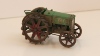
And some nice work Rob & Chris. That tractor looks like, and is in the same condition as one that sat rotting away in an old barn near the house when I was growing up.
 

Stevesopwith

Western Thunderer
Superb job on the tractor! Is it the 1917 Fordson from Universal Hobbies ?..... I've just ordered one for the same sort of scene. Any chance of a brief description of the weathering techniques Chris used?
 

Rob Pulham

Western Thunderer
Superb job on the tractor! Is it the 1917 Fordson from Universal Hobbies ?..... I've just ordered one for the same sort of scene. Any chance of a brief description of the weathering techniques Chris used?

Hi Steve, thanks and yes it is the 1917 Fordson from Universal Hobbies. Chris has also just "muckied" (rather than rusted) a 1929 FIAT tractor from the same source - pictures to follow.

Getting a brief description is a bit more difficult. Chris, being an artist uses techniques that she would use when painting a picture

It's all done with acrylics, from a mixture of Games workshop Beastial brown, Vallejo Model Air 080 rust and Anitas acyclic black (could be any sort of black though) along with touches of Reeves yellow ochre. This was applied with acrylic artists paint brushes in layers along with dry brushing and a large dose of imagination to think what a rusty tractor would look like - this is the bit that totally lack and I admire anyone with a creative imagination:thumbs:
 

Wagonman

Western Thunderer
Friesians were first imported to the UK in large numbers from Holland until 1892 when there was a freeze on imports to protect against a huge Foot & Mouth outbreak on the continent. For a decade numbers dwindled so far that the breed wasn't included in the 1908 census. In 1909 what was to become the British Frisian Cattle Society was formed. By 1912 1000 males and 6000 females were listed, and the import ban was lifted in 1914 with an official importation. In 1922 another importation occurred from South Africa, and a further one in 1936, again from Holland. After the war, there was indeed an expansion which lasted through the 80s, but it is perfectly proper to have Friesians even on your pre-Grouping or Grouping period layout as long as numbers are low for dates between the late 1890s to WW1.

Farmer Pickles.


Wow, thank you Adrian. Farmer Pickles. Where I grew up, when I wasn't in London, it was mainly dairy shorthorns, red polls (declining) and Guernseys – with the odd Jersey when they really wanted to fur your arteries. Few, if any, Friesians in Wiltshire. Yes I know the red poll was mainly an East Anglian breed but some did escape! BTW close reading of that Wiki article does imply that they breed was rare before the massive growth of the 1950s-1980s.

I stand by my comments regarding the loading of cattle... (is there an emoticon for a laughing cow?)


F Giles
 

Rob Pulham

Western Thunderer
I stand by my comments regarding the loading of cattle...

I agree with you Farmer Giles but at £3 a piece and with half a dozen wagons to "fill" they will have to have a bit of room:eek: I do have some partition for the others so I can reduce the standing room a bit.
 

Rob Pulham

Western Thunderer
Work on the turntable has come to a temporary halt. It's almost ready for painting but I need to change the filters on my spray booth extractor.

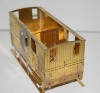
So to keep my hand in, I started this kit on Saturday. It's one that my good lady bought me for Christmas last year - a Connoisseur North British 20 ton brake van.

NBRBrakeVan003.jpg

NBRBrakeVan004.jpg

NBRBrakeVan012.jpg

Jim only provides a floor for the veranda section (not really a veranda on this one but you get the idea). So I made one up from some brass sheet. To bring it to the same level as the other floor I used some spare angle bracket from the turntable. Waste nowt!

NBRBrakeVan006.jpg

NBRBrakeVan007.jpg

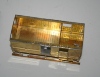
And inside the van

NBRBrakeVan011.jpg

NBRBrakeVan010.jpg

NBRBrakeVan005.jpg

I reinforced the roof with some square section nickel bar to make it clip into the roof. I will also add some longer springy bits down the sides to help the middle sit down properly.

NBRBrakeVan014.jpg

I also added some scrap etch strip to the back of the step supports and the brake brackets.

NBRBrakeVan013.jpg.

This is where I got to last night.

Today while sitting in the smallest room in the house, I had the thought. "I wonder if I have any photo's in my Tatlow LNER Wagons volumes that might give me any missing details." Have you ever wished that you'd had that thought earlier......?

Tatlow revealed a second set of handrails below those on the non veranda end. Not too difficult to add thought I. Then I noticed the very distinctive curved ends to the vertical handrails and the fact that they don't sit at 90% to the side of the van.

NBRBrakevan.jpg

Oh Bovver!!! Says I.

So the next job tonight is to see if I can make a jig to bend 4 of those - before I take the ones I made earlier off.
 
Top