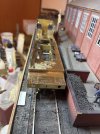
SimonD’s workbench

simond

Western Thunderer
Nice to see the RSU being used. I t does result in a nice, neat job.
Warren’s kits are very solid. The etches for the frames, spacers and cylinder formers are all 0.65 brass, which makes for a serious heat sink.

its obviously possible to use a big iron, or a gas torch, but the RSU is just so much easier. And very quick. I built mine a gazillion years ago and it has proved to be a very useful investment. They‘ll not replace a range of irons, and the 80W temp controlled Ersa is my go to, but for chunky jobs, there’s nothing to touch it.
 

simond

Western Thunderer
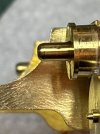
Cylinders went together ok, quite difficult to hold, and solder and not burn yourself, but got there in the end

image.jpg

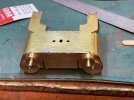
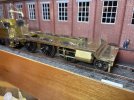
I started on the footplate after dinner, lots of riveting, and then soldered it together.

Front end wasn’t too bad, but the back end is really not easy.

image.jpg

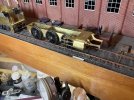
Could really do with some locators to get things in the right place first time. I’m sure I’ll get there in the end.

image.jpg

The tender front plate (shovelling plate, footplate?) will need taking off, and raising a few mm. The loco is sitting low at the moment, there are no springs yet.

that'll do for this evening.
 

jonte

Western Thunderer
At least you did something constructive with your time, Simon.

I wasted precious modelling time watching the Blues lose to a mediocre (at best) United side. Everton that!

Coming along nicely, Simon.

Jon
 

simond

Western Thunderer
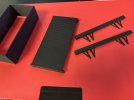
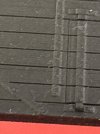
I left a little project on the printer at work last night. Bambu mini with 0.2 nozzle

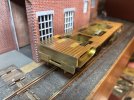
I am quite astonished at how good it is - this is a first shot and I have not yet added details to the interior, ends or the solebars.

I shall work up the CAD and have another go. It took 7 hours to print (but so what?) and cost pennies.

image.jpgimage.jpgimage.jpg

I think a quick jiffing and a blat with a spray can would make a quite acceptable wagon - and one on which all sorts of experimental detail and weathering can be practiced with impunity.

Cunning plans are chewing around my brain.

Best
Simon
 
Last edited:

simond

Western Thunderer
Have you tried with a resin printer Simon? I imagine the results will improve it further.

John
Hi John

I have done a lot with resin printing, and it is undoubtedly more precise, and gives a better surface finish, but this is really very good, and very much more accessible.


I'm an admirer of what you have done with your wagon works!

best
Simon
 
Last edited:

simond

Western Thunderer
Simon,

The plate between the loco and tender is the fall plate.
Thanks Phil, I know that, but I don’t know what the plate at the front of the tender, on which the loose end of the fall plate rests, is called. In the photo above, it’s the one with the “U” shaped cut out to clear the water scoop handle. They’re fitted on some kind of sheet metal brackets to raise the plate to match the loco footplate.

cheers
Simon
 

Pencarrow

Western Thunderer
Thanks Phil, I know that, but I don’t know what the plate at the front of the tender, on which the loose end of the fall plate rests, is called. In the photo above, it’s the one with the “U” shaped cut out to clear the water scoop handle. They’re fitted on some kind of sheet metal brackets to raise the plate to match the loco footplate.

cheers
Simon

I think I'd call it the plate at the front of the tender, on which the loose end of the fall plate rests.

Nice work with the printed wagon Simon.
 

simond

Western Thunderer
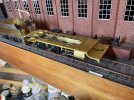
Well, it has taken pretty much all afternoon to get the back end of the footplate sorted. I made a cock-up which didn’t help, but I plead mitigating factors. The instructions are vaguer than a vague thing, there are no alignment features or marks, and after considerable searching, I conclude there are a couple of bits missing from the etch - as in, they exist in the instructions but not in brass. That said, I’ll probably find them now…

Anyway, I am quite pleased with the travails

image.jpg

image.jpg

image.jpg

Upper works, cab, firebox, boiler, smoke box. Probably not in that order…
 

Pencarrow

Western Thunderer
Well, it has taken pretty much all afternoon to get the back end of the footplate sorted. I made a cock-up which didn’t help, but I plead mitigating factors. The instructions are vaguer than a vague thing, there are no alignment features or marks, and after considerable searching, I conclude there are a couple of bits missing from the etch - as in, they exist in the instructions but not in brass. That said, I’ll probably find them now…

Anyway, I am quite pleased with the travails

View attachment 258629

View attachment 258630

View attachment 258631

Upper works, cab, firebox, boiler, smoke box. Probably not in that order…

What? You're reading the destructions?! You'll be asking for directions next....
 

RichardG

Western Thunderer
Well, it has taken pretty much all afternoon to get the back end of the footplate sorted. I made a cock-up which didn’t help, but I plead mitigating factors. The instructions are vaguer than a vague thing, there are no alignment features or marks, and after considerable searching, I conclude there are a couple of bits missing from the etch - as in, they exist in the instructions but not in brass. That said, I’ll probably find them now…

Supposing the parts were numbered so we began with part 1 and then fixed part 2 onto part 1, and then part 3 onto the assembly of 1+2, then instructions would only need to tell us about things which are not obvious. Perhaps, altering a part to make it fit; or using a non-standard method of assembly. This would force instructions to genuinely instruct.
 

simond

Western Thunderer
I’m not going to be too negative here, Warren taught me to fire some fifty years ago on the Ffestiniog ladies, Linda & Blanche, and I have built a few other kits from his stable with great pleasure. My 5205 is still probably my favourite.

But these instructions, though beautifully produced, are not hyper clear, and the etches are not actually numbered in them. And the views are all isometric, from the same viewpoint, which works well for the front, but not so much from the rear. So supposing the parts were numbered…

Would someone else have found this easier? Can’t answer that one.

Anyway, in addition to the satisfactory chassis, I now have a good, solid, flat, footplate. I have rivetted & rolled (but not yet soldered) the smokebox and conical barrel, but the firebox did not form nicely and I chose to retire to the pub. I‘ll have another look in the morning.
 

RichardG

Western Thunderer
Would someone else have found this easier? Can’t answer that one.

I am told, the key to easier kit building is to find the mindset of the designer. Work out how the designer would build the kit themselves.

I know, I find Jim Mcgeown's kits straighforward to build. He knows how he would build his own kit, and his instructions reflect this. Everything goes together. But some kit designers write their instructions as if they need to address all of the parts, but in a strange even bizarre sequence. For example, for the GWR Serpent I abandoned a few weeks ago, the builder is instructed to install the brake gear before adding the wheelsets.

I am beginning to think, some kits are merely a set of parts without any provision to ease assembly. A more thoughtful designer will arrange parts to fit together in a particular sequence, so adding one part makes it easier to add a subsequent part. And so different brands of kits earn their reputations.

And so, the first step to success is to work out whether you have bought a kit, something designed for methodical assembly; or a set of parts where really you are building your own model.
 

simond

Western Thunderer
Thanks Richard, that’s an interesting point, and I think entirely valid. Warren, apart from making kits, driving steam trains, and probably many other things made medieval armour and did quite a bit of model engineering, so I think his mindset reflected this.

I guess my background has conditioned my thinking too, I would really appreciate some detail sketches the show the edge of part A aligns or is offset by X mm from the edge of part B, as then I will contrive to make it so, first time, rather than have to unsolder parts that I have carefully and accurately assembled, wrongly.

I took the cook’s blowlamp to the cab and firebox subassemblies this morning. The firebox is now part assembled, and the cab will follow in short order. It’s all a learning curve…
 
Top