SimonD’s workbench

simond

Western Thunderer
Go with Tony’s comment: you have X grammes of weight, which you can have spread around one pair of driving wheels or five pairs, or anything in between. (Are there any six-coupled locos?). You can of course “waste” some of the available weight on bogies and pony trucks too.

The limiting tractive effort is mu * X. The area in contact makes no difference. Mu is the coefficient of friction, which, steel on steel will vary from 0.1 to 0.8. Probably a bit less on NS rail.

(in practice, the area in contact probably does make a difference but this is likely due to local contamination changing the mu.)

some values here
And here

notice how the friction coefficient drops significantly from static to sliding.

So imagine the effect of loose/sloppy coupling rods. The driven axle might well slip before the other axles are actually seeing any torque at all, and the shock might well cause all of them to slip. Stop your loco, (reverse to slacken the couplings?) and start again gently.

oh, and ignore Gresley & Bulleid: Churchward had it right. Trailing trucks are bad for adhesion, due to weight transfer.

In response to Martin’s point, in most models, I’d expect the motor to provide more than enough torque to provoke wheelslip unless the model is overweighted. If not, the motor will be stalled and will rapidly overheat, which can destroy it.

The stalled current is the deciding factor for the DCC chip current limit too, unless it can’t stall, of course, in which case the peak current at wheelslip will do. I’ve used standard “HO” decoders since I started playing with DCC sone 28 years ago, and I’ve only fried a few chips, and none of them were due to stall current overload, except one where the gearbox jammed.

You're a lucky modeller if the trains you’re running are big enough to stop your locos pulling them
 

Ian@StEnochs

Western Thunderer
For slow speed locos, which pick up from the track, compensation is fine, keeps all wheels in contact with the rail and evens out any high/low spots. However for locomotives that run at speed live springs do all above but also let the body float rather than bump along. Quieter running is an additional benefit but at the expense of more complicated construction.

Ian.
 

40057

Western Thunderer
In response to Martin’s point, in most models, I’d expect the motor to provide more than enough torque to provoke wheelslip unless the model is overweighted. If not, the motor will be stalled and will rapidly overheat, which can destroy it.

The benefits of using electricity! Clockwork motors are generally not very powerful relative to their weight. A large 0 gauge clockwork loco might easily weigh close to 5lb (2.2kg). Depending on the rolling resistance of the coaches, radius of curves, the particular motor and the characteristics of the main-spring, haulage capacity could be anywhere between 2 and 7 main-line bogie coaches. Slipping is pretty much unknown. However, when I have had to test clockwork motors without their coupling rods, they do slip and will consequently pull hardly anything. In respect of not normally being limited by adhesion, I would say the same for live steam. Generally much more power than clockwork, but locos are typically heavy. So they will pull more, but still rarely slip.

Martin
 

simond

Western Thunderer
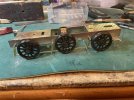
Loose bearings on middle axle can accommodate more than enough!

image.jpg

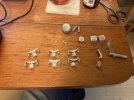
I shall make up the brakes this evening, that leaves the water scoop to do. The cast WM parts are useable but do not have the bosses for the tie rods and I have a similar set up on CAD already, so that‘ll be a print.

the other WM bits are variable. The vac tank doesn’t fit the support and the support doesn’t fit the chassis, so the 3DP I did for the Manor will be modified. Dome and vents are clean and round, and fit, so can be used. The tank lifting ring trunnions are ok, but it’ll be easier to print new ones than drill the cross holes, the tool boxes & water filler ditto, bit of flash, useable but why bother, and the axleboxes would be loads of work, so it looks like a CAD evening…

image.jpg


so, some bits we have already

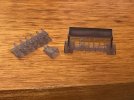
image.jpg

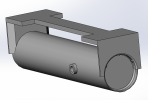
though I will need to modify the vac tank to fit to the inner chassis. I also need to revise the uptake pipe for the scoop.

Revised vac tank

1767560250460.png

Modified scoop

1767559293749.png

And some bits we need to start from scratch

1767559079743.png
At least this is the right size (pg 149 and 151 of GWRJ issue 19)

Water filler. drawings are not detailed. Not sure of dimensions.

1767562012880.png


It will, however, fit (and assuming the print works ok, will be flash free)


Enough for tonight
S
 
Last edited:

simond

Western Thunderer
The benefits of using electricity! Clockwork motors are generally not very powerful relative to their weight. A large 0 gauge clockwork loco might easily weigh close to 5lb (2.2kg). Depending on the rolling resistance of the coaches, radius of curves, the particular motor and the characteristics of the main-spring, haulage capacity could be anywhere between 2 and 7 main-line bogie coaches. Slipping is pretty much unknown. However, when I have had to test clockwork motors without their coupling rods, they do slip and will consequently pull hardly anything. In respect of not normally being limited by adhesion, I would say the same for live steam. Generally much more power than clockwork, but locos are typically heavy. So they will pull more, but still rarely slip.

Martin
Thanks Martin, this makes sense, and of course, neither a clockwork, not a steam, loco will suffer from stalling. They’ll sit there til they’re “helped”. This isn’t the case with an electric loco, the motor will cook, terminally, if left long enough.
 

David Halfpenny

Western Thunderer
(From p 97 of this thread)
The bogies are 3DP inners with Delrin chain drive (purchased a couple of years back, it seems like hens teeth all of a sudden)

Good News, Simon!
A spool of Delrin chain arrived today, direct from Gregg Carson at Serv-O-Link.
I phoned him to say thanks and he's in good spirits, intending to work another ten years.

Delrin Chain.jpg


For those who quite reasonably dread how much things might cost, 14 feet of 1/8" pitch Delrin chain cost $99.68 plus $18 postage plus £15 UK VAT plus £8 Post Office handling fee, which totals £8 a foot.
Gregg's minimum order is $30. Full price list: Prices - Serv-O-Link Corp.
 

James

Western Thunderer
For slow speed locos, which pick up from the track, compensation is fine, keeps all wheels in contact with the rail and evens out any high/low spots. However for locomotives that run at speed live springs do all above but also let the body float rather than bump along. Quieter running is an additional benefit but at the expense of more complicated construction.

Ian.
There are some locos, like the YEC Janus types, where a smooth, sprung chassis would look wrong!
 

simond

Western Thunderer
Thanks David,

I do wonder what the problem is, it’s obviously available, but perhaps just not as conveniently as heretofore.

I'm in the happy situation that having built my second (and presumably last) 7mm diesel loco I probably don’t need any more, but thank you for thinking of me.

Herewith the diseasel roster.

image.jpg

The near one is an Ixion model of the GW Fowler, number 1, mildly modified, the second is an Atlas model, donated by a pal, and quite aggressively modified to represent a loco made famous by the good Reverend Awdry, for a certain Master D who was then about two and is now 28, and the third, for which I purchased the delrin drive, is a BPRC Big Big Hymek, with FDM bogies, Ultrascale 13:1 gears and two motors from redundant HP Deskjet printers, all controlled by a Micron receiver, and glazed, with 3DP driver, control desks, fuel tank, etc.

I think my diesel itch has been scratched, or at least, when the pale green is painted on the Hymek, and it’s handrails are made and fitted, will be!

thanks again
Simon

EDIT. the bright wheels on the Manor will have to be dealt with…
 

simond

Western Thunderer
One of the most pleasing aspects of this Javelin kit is the finesse of the rivet half-etched holes on the back of the parts. They are uniformly tiny and ensure that the rivet press leaves a neat line of equispaced indentations. I have had to fight with some kits whose rivet guide marks resemble the craters Tycho and Copernicus in both diameter and circularity…. Not here, happily.

image.jpg

the flare was fraught with challenge. I suspect I was too timid with the annealing process, so it was difficult. I clamped the tender sheet work to a piece of paxolin with a piece of silver steel rod as a former, using five toolmakers clamps and then used a Stanley blade to slip a ruler underneath it. I then grunted, and lifted and generated a flare. I guess I’ll find out whether it fits everything else when I come to do the assembly.

The solder is really invisible, image.jpg

because I haven’t yet used any :))

Not sure if I’ll commit myself to the next big step this evening or tomorrow.
 

LaScala

Member
Right Ho.

Before attacking Chris’ loco, let’s have a look at my 45xx. Springside kit, my first 0 gauge loco build, 1997. Been DCC’ed, obviously pre 3DP from the plasticard speaker box. White metal pony trucks have suffered a bit, & brakes seem to have gone entirely AWOL but the reasons for a rebuild are a) the Portescap whine, and b) rigid chassis.

The years have otherwise not been too unkind… and I’m rather fond of the old girl.

View attachment 197983

So I have two Warren Shepherd pony trucks, ditto brakes, a set of Premier jointed rods, a set of Slaters brass horns & axle locks, and a Premier two sage helical 30:1 gearbox with Canon 1833

View attachment 197984 underdone

I’m also armed with the CLAG spreadsheet and Solidworks. Let battle commence!
Hi Simon,
I happily chanced on this today as I too have an old Springside 45xx, bought on Ebay about 20 years ago as a seriously underdone part build.
Got it finished and running more or less as intended including the as designed Mashima rigidly soldered to the substantial frames.
This has worked OK for many years, the substantial weight aiding current collection even though built rigid.
The reason for current interest is that the half baked motor to frame joint failed and no longer having a massive old school soldering iron, I could not reattach it.
Rather than buy a cheap iron and bodge the drive train, I fitted an Ultrascale gearbox and a new Taff Vale Mashima lookalike.
I have already changed the driving wheels to Slaters as the Springside originals were all permanently wobbly so no issues with axle diametre.
I like your idea of Warren's pony trucks which I may copy ubt will pass on the great work on CSBs.
 

simond

Western Thunderer
hi,

mine came with Slaters wheels, and when I built it I fitted a Portescap complete with gas-turbine whine, so I never tried the rigid chassis/gearbox. It definitely runs more smoothly with the CSB, though compensation would be a simpler alternative.

atb
Simon
 

David Halfpenny

Western Thunderer
it’s obviously available, but perhaps just not as conveniently as heretofore.
When buying Delrin chain / sprockets direct, the inconveniences remain as they've always been:
- the one-of-a-kind chain-making machine needs almost daily attention, which can delay dispatch a few days,
- even Texans need a break from time to time,
- transatlantic post takes weeks not days,
- $30 minimum order.
Buying from a retailer eliminates all of those snags provided he has stock, but adds another whole layer of inconveniences when he doesn't.

You've done the right thing for you :)
 

jonte

Western Thunderer
A bit late to the party, Simon, but perhaps what follows might prove of interest with regard to your flare forming.

It’s a thing-ama-jig I cobbled together in an attempt to form the flare of an Albert Finney tender kit a few years back.

Rather than bore you with spiel, you can see the photos from about half way down the page of my link, and page 3 :


The flare wasn’t too pronounced from prototype type pictures, but the handiness of this plonked together affair is tgat you can furnish it with rod of appropriate diameters depending upon the amount of flare required.

A bit late as I say, but perhaps handy fir another venture?

Best,

Jon
 

simond

Western Thunderer
Thanks Jon,

the flare is ok, but there has to be an easier way. If I were making them day in day out, I’d make a tool for the job, and I feel that maybe I should have for this one-off. I also think it was too timid in the annealing. You can’t win with this, too much and it’s like processed cheese, too little and it’s like armour plate. I don’t know how to find the middle ground.

A little voice says “rub soap on it, and watch the colour change”, but I can’t remember whether that’s annealing brass or tempering steel…
 

Ian@StEnochs

Western Thunderer
Thanks Jon,

the flare is ok, but there has to be an easier way. If I were making them day in day out, I’d make a tool for the job, and I feel that maybe I should have for this one-off. I also think it was too timid in the annealing. You can’t win with this, too much and it’s like processed cheese, too little and it’s like armour plate. I don’t know how to find the middle ground.

A little voice says “rub soap on it, and watch the colour change”, but I can’t remember whether that’s annealing brass or tempering steel…

I think the soap trick only works on aluminium.
 
Top