

You are using an out of date browser. It may not display this or other websites correctly.
You should upgrade or use an alternative browser.
You should upgrade or use an alternative browser.
Giles' misc. Work bench.
- Thread starter Giles
- Start date
That's more the ticket  The only thing I can nitpick is that there is a 1/2" outside border that's rounded over:
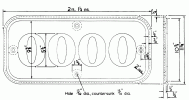
This is picked out in whatever the main body colour is. It's subtle, admittedly.
Attached is a PDF of my artwork for the 1423 plates modified to suit 9018 - It *should* import into Lightburn and retain cutting layers if you care to play further.
Pete S.
The only thing I can nitpick is that there is a 1/2" outside border that's rounded over:This is picked out in whatever the main body colour is. It's subtle, admittedly.
Attached is a PDF of my artwork for the 1423 plates modified to suit 9018 - It *should* import into Lightburn and retain cutting layers if you care to play further.
Pete S.
Attachments

JimG
Western Thunderer
Latest with the Fibre Laser....
Nice square inside corners which is hardly possible on a CNC mill.
Jim.
Giles
Western Thunderer
I will get round to measuring that for you.
Meanwhile, I've re-cut the frames and motion bracket to tighten a couple of things up and to increase the thickness of the expansion link brackets, and silver soldered the result together, so as to allow risk free solf soldering of other things, and allowance for the fact that I will be cutting the centre section of the motion bracket away entirely to clear the gearbox, and I don't want either of the remaining halves falling off!
But prior to this, I had fitted the expansion link brackets to the motion bracket by cutting the link brackets with very long (rectangular section) legs to fit through slots in the motion bracket, which, once in position, were twisted with pliers to restrain and tighten them in position, whereupon they were silver soldered.
Also, the guard irons were fitted using fire wire and the extremely small holes
So it's now looking more recognisable

Meanwhile, I've re-cut the frames and motion bracket to tighten a couple of things up and to increase the thickness of the expansion link brackets, and silver soldered the result together, so as to allow risk free solf soldering of other things, and allowance for the fact that I will be cutting the centre section of the motion bracket away entirely to clear the gearbox, and I don't want either of the remaining halves falling off!
But prior to this, I had fitted the expansion link brackets to the motion bracket by cutting the link brackets with very long (rectangular section) legs to fit through slots in the motion bracket, which, once in position, were twisted with pliers to restrain and tighten them in position, whereupon they were silver soldered.
Also, the guard irons were fitted using fire wire and the extremely small holes
So it's now looking more recognisable

Giles
Western Thunderer
Regarding the accuracy - I've just measured the assembled frame, and it's within a couple of hundredths of a millimetre of the drawn dimension (which I confess is 0.5mm too long, as I've used overly thick material for the beams at both ends....)
We now have engine chassis at both ends, and a pause, as I haven't drawn up the boiler cradle.
We now have engine chassis at both ends, and a pause, as I haven't drawn up the boiler cradle.

michael mott
Western Thunderer
Giles it would be very challenging to make those guard irons using conventional tooling. Watchmakers certainly but for the rest of us mortals doubtful, most impressive and inspiring indeed.
Michael
Michael
Giles
Western Thunderer
Well, the joy of it for me is that it produces stuff that I certainly couldn't do to anything like the standard either! I'm in the same boat!
What I am also finding interesting though, is as I am drawing up the boiler cradle, although I started drawing 'half-etch' lines for location things like foot plates and valances, I am now thinking in terms of square hole/long square wire tab twist to tighten, cut and file flush after soldering, which will hold everything tight and square during the soldering process. So different assembly processes to suit the new technology?
As I wright, I live 150 yes from the Greenford branch, and I hear the unmistakable sound of a steam loco taking off quite briskly (having just turned on the triangle?) But I can't see it without climbing out of a window which I really can't be bothered to do.....
What I am also finding interesting though, is as I am drawing up the boiler cradle, although I started drawing 'half-etch' lines for location things like foot plates and valances, I am now thinking in terms of square hole/long square wire tab twist to tighten, cut and file flush after soldering, which will hold everything tight and square during the soldering process. So different assembly processes to suit the new technology?
As I wright, I live 150 yes from the Greenford branch, and I hear the unmistakable sound of a steam loco taking off quite briskly (having just turned on the triangle?) But I can't see it without climbing out of a window which I really can't be bothered to do.....
Giles
Western Thunderer
I've drawn up the bulk of the boiler cradle, but been fairly unconventional about it. I may be pushing my luck too much, but one has to try these things (the valance is only 0.8mm deep for instance). The actual pivots I intend to print ball and sockets with simple springs to retain them. I did this for the bogies on the 0-14 Ashanti diesel, and they worked quite well. But these will need to be significantly smaller.

Giles
Western Thunderer
The large bits of the boiler cradle are there.... it was an experience... as in the drawing above, I took a big risk with laser cutting the valance under the edge of the running plates. These are 0.8mm deep, with teeny tongues....
The first effort resulted in a thin charred mass in curly pieces, after which I remembered that I had bought a sheet vise for this sort of job. This is a vise whose jaws are each horizontal clamps which grip the edge of a small sheet, and the handle that tightens the vise moves the jaws further apart rather than closer together, thus keeping the sheet of metal unter tension whilst it is being cut.
This was more successful, but required careful adjustment of 'passes' to the minimum to do the job in order to get a successful result, which I eventually did.
I used the same settings in the vise to cut the running plates as well.
The first time I've used that vise, and we'll worth it....
Those really fine tongues were a real fiddle to assemble, as my eyesight even with magnifiers wasn't really up to it. It would have been fire in 7mm though.
I couldn't risk silver-soldering this, as the distortion would have been very significant, so it was all soft soldered. The principle of long tabs and twisting them works very well though. I think I might have seen it before - does MOK use this?
The first effort resulted in a thin charred mass in curly pieces, after which I remembered that I had bought a sheet vise for this sort of job. This is a vise whose jaws are each horizontal clamps which grip the edge of a small sheet, and the handle that tightens the vise moves the jaws further apart rather than closer together, thus keeping the sheet of metal unter tension whilst it is being cut.
This was more successful, but required careful adjustment of 'passes' to the minimum to do the job in order to get a successful result, which I eventually did.
I used the same settings in the vise to cut the running plates as well.
The first time I've used that vise, and we'll worth it....
Those really fine tongues were a real fiddle to assemble, as my eyesight even with magnifiers wasn't really up to it. It would have been fire in 7mm though.
I couldn't risk silver-soldering this, as the distortion would have been very significant, so it was all soft soldered. The principle of long tabs and twisting them works very well though. I think I might have seen it before - does MOK use this?

simond
Western Thunderer
I believe so, though I’ve not done one.does MOK use this?

Dog Star
Western Thunderer
Yes - successfully, by me.The principle of long tabs and twisting them works very well though. I think I might have seen it before - does MOK use this?
Giles
Western Thunderer
Major metal work on the boiler cradle done. I do dislike soft soldering on this scale!

Giles
Western Thunderer
A blunder - but one worthy of note..... this loco is intended to be a Sneyd Colliery type, hence details like the top feed, and smokebox rivets, but smaller water tank capacity.... I had mistakenly thought that the brake arrangement was the later compensated system, as fitted to William Francis - which has a pair of central steels mounted on the central stretcher, and is also identifiable by having the pull rods at roughly the same height. But the works photo of the Sneyd loco has Simple (non-compensated) braking, with more delicate steels mounted on the inside of each of the boiler cradle main frames (the pull rods also being obviously high/low).
It was quite an easy job to cut correct replacements and fit them, and much easier than anticipated to remove the old ones without damage to anything.
The original Vivian also had the Simple braking.
Guest Keen No 12 and William Francis had Compensated braking

It was quite an easy job to cut correct replacements and fit them, and much easier than anticipated to remove the old ones without damage to anything.
The original Vivian also had the Simple braking.
Guest Keen No 12 and William Francis had Compensated braking