A Tale of Two Serpents

magmouse

Western Thunderer
Is the beast being tamed? Perhaps a little.

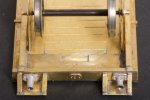
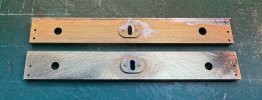
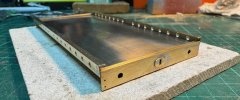
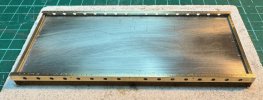
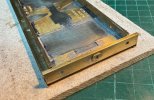
New floor made and attached, together with the solebars:

IMG_6810.jpeg

IMG_6811.jpeg

As noted above, the solebars are about 0.5mm in from where the kit positions them, and are now the correct distance apart.

That's enough for tonight - but I leave it feeling a little more hopeful than I have been. It feels pleasingly solid even at this stage, and hints of the prototype's character are beginning to emerge. I'm pleased to have the correct relationship between the sides and the bottom flange of the solebars. Most of the photos of the prototype are pretty much side-on, but we so often have a view looking down on models, the degree of overhang becomes important.

Nick.
 

paulc

Western Thunderer
S
Mmm. don't get me started on Councils wasting public money. Having worked for a council for 20 years I have first hand experience.

How does, give a piece of land away, then buy it back for 5 million grab you...
Sounds like someone got a backhander .
 

RichardG

Western Thunderer
As noted above, the solebars are about 0.5mm in from where the kit positions them, and are now the correct distance apart.

My thoughts:
  • If we suppose the kit W-irons are scale height then they cannot be any closer together because they would overlap each other on the etch of the lower floor
  • The designer has chosen to use white metal for the springs, and these need a thick tab to hold them together - without the tab they will fall apart (I know this :oops:)
  • So to make room for the tab, the solebars have to be located further out than they really ought to be
  • The appearance of the model is made worse by the bottom flanges of the solebars being too broad (I agree with Nick, this was probably done to make folding esier)
Nick has been able to move the solebars inwards because he is using third-party W-irons and springs. I need the solebars to remain in their original places because I want to persuade the tabs on the spring castings to go into the gaps between W-iron and solebar.

DSC_1789.jpeg
There is very little space for these tabs. Really, the solebars could usefully be even further outboard.

Looking at this photo I feel my efforts on the brackets under the ramps look so shoddy, yet I have tried so hard. I would have found the brackets easier if their half-etching was on the other side and broad enough to let the parts fold up. You can see where I deliberately broke the parts and re-assembled them in position on the model. Next time I could try making the half-etched lines broader.
 

magmouse

Western Thunderer
I agree with your analysis, Richard - though I hadn't thought about the design factor of the fold-up (down?) axle guards. The irony there, of course, is that if they had been correctly modelled as shorter than a standard axle guard, the solebars could have been the correct distance apart. Once again, one has to conclude the designer didn't have the GA drawing.

Nick.
 

RichardG

Western Thunderer
View attachment 255367
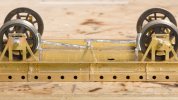
For some fresh entertainment, the backs of the axleboxes don't reach all the way to the W irons.

The W irons are in their correct places, with their visible parts about a millimetre behind the solebars. On the prototype, the W irons had an offset so they fitted flush onto the backs of the solebars. The kit doesn't represent this offset (fair enough), and so the W irons appear to be floating in mid air from this viewpoint.

I am thinking of adding some styrene shims on the backs of the axleboxes, and fixing the castings into place with glue.

I could break off the axleguards, file down their tops to make them shorter and reattach them further inboard, to make more space for the tabs on the spring castings. But if I do this, the gap between the axleboxes and the W irons will be even bigger. I will leave things alone for now.
 

magmouse

Western Thunderer
I could break off the axleguards, file down their tops to make them shorter and reattach them further inboard, to make more space for the tabs on the spring castings. But if I do this, the gap between the axleboxes and the W irons will be even bigger. I will leave things alone for now.

This makes me wonder - have you checked the buffer height on your wagon (rail head to buffer centres)? Given you - correctly - raised the buffers relative to where they are on the kit, but the kit axle guards are ‘standard’ and therefore too high for this wagon. I’d expect your buffer height to be too high now, but there are so many small variables in play, that may not be the case.

Nick.
 

RichardG

Western Thunderer
The buffer centres on my Serpent are going to end up about 24.5 mm above rail level, representing 3ft 6in. The GA shows the usual 3ft 4in.

This means, the buffers will be level with those on a Dapol 5-plank RCH wagon; and noticeably higher than those on a sample of my kit-built wagons.
 

magmouse

Western Thunderer
I’ve checked a few drawings from the same period as the Serpent, and 3’5 1/2” seems typical, not 3’4”. I feel a review of buffer heights coming on…. (Though not immediately as I am out and about).
 

Tony Overton

Western Thunderer
I’ve checked a few drawings from the same period as the Serpent, and 3’5 1/2” seems typical, not 3’4”. I feel a review of buffer heights coming on…. (Though not immediately as I am out and about).
Nick You've raised a question that has troubled me for a while, buffer centre to rail height and axle guard size (height) and their dimensions generally. Kit manufacturers seem to have provided us modellers with a 'one size fits all' axle guard etch, be it Midland or GWR, for obvious reasons, but, some times this creates issues.
Its another rabbit hole .......... What information I have studied has been from wagon G/A's. For some reason axle guard drawings are less common, rare perhaps.
Tony
 
Brake gear (Richard)

RichardG

Western Thunderer
. . .

View attachment 255949
Infuriatingly, the lack of refinement continues to the end. The castings for the brake gear are too shallow and too short. I want brake gear on only one side so I can try for a cut and shut job.

I have written to Ennis75 to see if they can supply a better casting.

DSC_1794.jpeg
I have received a reply from Ennis75 along the lines of "we will look into this" so I have built a set of brake gear using a cut and shut job on the two castings supplied in the kit.

The brake shoes are filed down to resemble the profile of the ones shown on the GA. They looked a bit undernourished afterwards so I padded them out with styrene. This means the curvature is slightly wrong, but the fit is better than seeing daylight here! The brake hangers no longer line up with their fixings on the solebar either but this is a consequence of making the most out of the parts supplied in the kit.

I have straightened up the dodgy bracing struts seen in my post this morning. This leaves me to glue on the spring/axlebox castings and sit back and watch Nick's model take shape. What a game this kit is turning out to be!
 

Dog Star

Western Thunderer
Looking back over this topic given the thinking that has gone into the work to date, I am prompted to ask...

"Who is going to be the first to distill the essence of the accuracy / modelling gain, as recorded here, and produce a more refined / accurate model from the basic kit?" ... that is to build from start to finish without:-

a) backtrack of the construction sequence;
b) omitting desirable alterations / upgrades;
c) presenting the result without a liftvan secured correctly.

Note, to build without reference to B2B of the wheelset.... FS or S7 is not important here because this topic is about moving a kit onwards by mutual improvement.

Rgds, Graham
 

magmouse

Western Thunderer
The brake hangers no longer line up with their fixings on the solebar either but this is a consequence of making the most out of the parts supplied in the kit.

If you mean the group of five rivets, two of those are for the axle guard, and three are for the cross member that is part of the chassis. The brake hanger is attached to that cross member, and sits slightly inboard of it - just as you have it :thumbs: .

What a game this kit is turning out to be!

Sure is!

"Who is going to be the first to distill the essence of the accuracy / modelling gain, as recorded here, and produce a more refined / accurate model from the basic kit?"

Dave @daifly mentioned he had this kit in his stash - no pressure, Dave! :D
 

magmouse

Western Thunderer
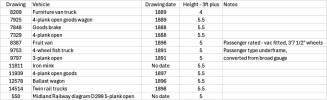
A quick survey of buffer heights, from drawings of the period of and after our 1889 Serpent:

1769453422838.png

All 'normal' GWR wagons are 3'5 1/2" - with the 3'5" ones being either passenger rated vehicles with larger wheels, or broad gauge conversions. The Midland Railway D299 is also 3'5".

The 3'4" of the Serpent seems to be an outlier - and as I suggested earlier in the thread, I think this is part of a strategy to maximise the available load height.

Nick.
 

daifly

Western Thunderer
Dave @daifly mentioned he had this kit in his stash - no pressure, Dave! :D
Since I have no actual need for this wagon and in the light of the experiences of both of you in trying to construct a wagon that looks like wot it oughta, mine will be sold on in its virgin condition when I get back from my hols!

Life is too short to spend a lot of time rectifying the designers errors. I’m still enjoying watching and learning how you both overcome the problems though!

Dave
 

magmouse

Western Thunderer
Since I have no actual need for this wagon and in the light of the experiences of both of you in trying to construct a wagon that looks like wot it oughta, mine will be sold on in its virgin condition when I get back from my hols!

Life is too short to spend a lot of time rectifying the designers errors. I’m still enjoying watching and learning how you both overcome the problems though!

Dave

Coward! Don't blame you though...

Nick.
 
Final useful photo before abandonement (Richard) New

RichardG

Western Thunderer
DSC_1797.jpeg
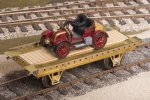
Anthony Garten (Poppy's Woodtech) has made me this plywood panel to represent the planked part of the deck. The Renault is just about wide enough to straddle the scale 3ft 6in boards.

To recap slightly, the top surface of the upper deck (the brass sheet here) is about 0.5 mm higher than it ought to be. I have made new headstocks, which sit close to the right place relative to the solebars but not relative to the deck. And so, I have added some 0.4 mm shims on top of the headstocks so the ramps have something suitable to climb over and look the right shape.

On the prototype, the GA shows the planks were about 51 mm thick. This scales to 1.2 mm. The boards at each end were wedge-shaped so they climbed to finish level with the tops of the headstocks. I am simplifying things by using a piece of 1.5 mm ply, which finishes level with the tops of the headstocks without needing to climb at the ends.

The excess thickness (0.3 mm) will be harder to see when the edges of the ply are coloured to match the top and indeed when the wagon is carrying a vehicle.
 

magmouse

Western Thunderer
Another episode of 'How to Tame Your Dragon Wagon".

As Richard did, I have added a strip to the top of the headstocks to increase their heights. Here is the strip added, and after clean-up:

IMG_6826.jpeg

It's frustrating to have to deliberately make the headstocks over scale height when there were correct before, but it is a question of where to put the compromises. Because the floor is too thick, a scale headstock would stick up above the floor by too little. This messes up the relationship between the iron floor, the wooden floor and the ramps. Better - I decided - to add to the headstocks (largely hidden by the ramp extension) and get the top deck closer to correct (highly visible from the typical high level view of a model - and also very characteristic of this vehicle*).

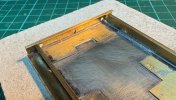
Headstocks are now attached, after some fettling to get them to fit right. All the small holes on the top face of the sides need sorting - drilling out the ones clogged with solder, and filling the ones that shouldn't be there, where the solder has failed to do that.

IMG_6828.jpeg

IMG_6829.jpeg

IMG_6830.jpeg

IMG_6831.jpeg

Nick.

* In general, I am less motivated by accuracy than trying to capture the 'character' of a wagon. This involves working out which features give the wagon its character, and focusing on getting those right. I am more tolerant of other aspects that seem less critical to capturing the character. Of course, what the character of a wagon is is highly subjective - but then, so is the whole business of trying to catch the flavour of a place and time in model form.
 
Top