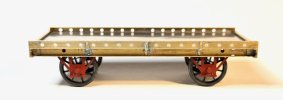
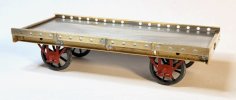
A Tale of Two Serpents

RichardG

Western Thunderer
I ruined all four spring/axlebox castings trying to get them to fit onto my model. Nick kindly sent me his (he is using some third party ones) and I have now ruined the first of these. I think I have got to accept, I don't have the skill set to use these castings.

Please, could anyone suggest a source of GWR axleboxes and springs for 7mm scale? The distance between the centre of the Slater's axle bush and the underneath of the solebar is 9.8 mm. Given the way I am trashing castings which are too big, it might be best to get something undersize and shim it out under the solebar.

They could be white metal, brass, resin, plastic or 3DP, in the early or later styles. I don't really mind :thumbs:
 
New axleguards (Nick)

magmouse

Western Thunderer
Well, the fight taming continues...

As mentioned in an earlier post, the prototype appears to use axle guards of a type intended for 3'7" wheels, thereby reducing the distance from axle centre to solebar. This in turn lowers the floor by an inch and a half, gaining a little height for the load.

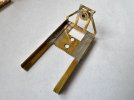
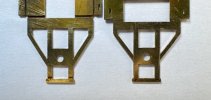
I also mentioned that I had decided to use a set of etched axle guards from Slaters - originally intended I think for MR fitted vans, I think. As @Overseer pointed out, these might not be quite right, and sure enough, a check against the drawing shows that the angled parts were at the wrong angle. So, I cut through the angled part at the bottom, parallel with the vertical, filed a bit off the end, bent it to a less steep angle, and soldered it back into place.

Here, on the right, the cut, and on the left, bent to the correct angle, ready for filing:

IMG_6837.jpeg

This comparison shows the difference - a noticeable and worthwhile change, I feel:
IMG_6833.jpeg

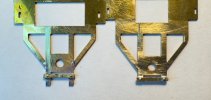
Once filed, the joint was soldered. The keeper also needed moving up, so these were cut off the etch and soldered back in the right place - seen here before and after cleaning up:
IMG_6840.jpeg

The next problem was that the Slaters units, if folded up as intended, would be too narrow. As well as the visual impact of this, it would mess up the relationship between solebar, axle guard , axle box and spring. I therefore decided to widen both the fixed and the rocking unit by cutting them up and soldering sections of brass angle to hold them together at the right width. The rocking unit had to be cut into three, to keep the slots for the attachment plate centred.

IMG_6846.jpeg

I will paint these before final assembly, and not attach them to the wagon until that is painted, so I don't have to worry about masking the wheels.

Having widened the axle guard units, I needed to pack out the bearings using 5BA washers:

IMG_6848.jpeg

Naturally, the amount needed wasn't an exact number of washers, so I made some half thickness ones by soldering them to a bit of spare fret and filing them thinner - you can see that in the picture above, where the left hand one of the three is half thickness.

A couple more pictures:

IMG_6849.jpeg

IMG_6850.jpeg

At this point I was feeling I had just spent several hours sorting out issues with both the kit itself, and the Slaters parts... The modelling gods then decided I was complaining too much about the shortcomings of other people's work, and perhaps too self satisfied about my own. They soon found a way of putting me in my place. You may recall I had added a new nickel silver floor on top of the kit sub floor. I had removed the axle guards from the sub floor, thinking this would make space for the new Slaters units to attach directly to the underside of my new floor.

Turns out - the Slaters units are too wide for the space left by the kit axle guards. After some wailing and gnashing of teeth, I considered my options:

1. fill the space with some packing, and attach the Slaters units to that, raising the height of the wagon by 0.5mm. Sounds innocuous, right? However, the distance from the centre of the axle to the underside of the solebar was already 8.5mm against a prototype equivalent to 7.875. Worse, the kit solebars are about 0.5mm too deep, and of course the floor is 0.5mm too thick. All these half millimetres were adding up - and a defining feature of the prototype is the way it is designed to maximise the available load height.

2. File some metal off the edges of the Slaters units - the amount needed wasn't much. The risk here was filing through the metal where the fold is, such that the strengthening ribs that run the width of the unit came away. Not a problem where I had already soldered the L section, but the side yet to be soldered has little metal to remove and still stay in one piece. I could of course file the corner off after final assembly, but at that point, there's a risk of damaging paintwork, and filling the bearings with brass filings. Possible, but unattractive...

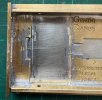
3. Mill out the unwanted material of the sub floor. Sounds easy - two problems. One - I don't have a mill. Two, on inspection, it turned out the floor had taken on a slight curve across its width, higher in the middle (when the right way up). I have no idea how or when in the process that happened, but there it was. So - the option was to use a small mill bit on my Proton pillar drill, with the wagon attached to the X-Y table, thus making a crude mill. With no very accurate vertical control, the risk was cutting into the 8 thou nickel silver floor, and leaving a witness mark on the other side - this compounded by the curve in the floor.

Reviewing these options, I rejected (1) - if I was going to do that, I might as well build the kit as intended, and call it done. While the model will have compromises, I want to catch that 'like an ordinary wagon, but somehow a bit lower' character if I possibly can.

That left 2 and 3. I opted for 3, with 2 as a fall-back. After some anxious moments, I was able to carve out enough space for the fixed axleguard unit (the rocking one doesn't need the clearance:
IMG_6856.jpeg

It is NOT pretty, and in one place there is the slightest of witness marks on the top face of the floor, but it will disappear with paint and dirt, I think. A useful reminder to me to think a bit harder before committing to soldering the top floor on - it would have been so simple to sort this issue while I could file the holes in the sub floor out bigger.

So, the beast is still fighting back, but step by step it is coming under control....

Nick.

 

RichardG

Western Thunderer
1. fill the space with some packing, and attach the Slaters units to that, raising the height of the wagon by 0.5mm. Sounds innocuous, right? However, the distance from the centre of the axle to the underside of the solebar was already 8.5mm against a prototype equivalent to 7.875. Worse, the kit solebars are about 0.5mm too deep, and of course the floor is 0.5mm too thick. All these half millimetres were adding up - and a defining feature of the prototype is the way it is designed to maximise the available load height.

I think it is worth measuring my model to show how much effort Nick is doing here to compensate for some of the errors in the kit.
  • The height of the floor on the prototype is easy to determine from the dimensions given on the GA. We have 34 inches from rail head to the underside of the solebar, and 9 inches for the height of the solebar. Add a nominal half inch (rather a lot!) for the thickness of the floor gives a distance of 43.5 inches. That's handy! So without reaching for the calculator, the top surface of the floor ought to be one inch (25.4 mm) above rail head.
  • On my model, one side is slightly higher than the other - probably because of the way I folded the W irons. The average height of my floor above rail level is 27.6 mm, which is more than two millimetres higher than the scale distance. The errors are from incorrect design of the W irons; incorrect vertical placement of the W irons; solebars too tall; floor too thick.
As a "finescale" modeller, I do tend to round dimensions to the nearest tenth of a millimetre, and I am happy to overlook an entire millimetre here and there. Nevertheless, the floor is 9% too high. That's enough to spoil the character of a model. My consolation is, I don't have any photos showing the floor of a prototype.

The kit makes the wheelbase 77 mm so spot-on for a scale 11 feet. This is the only scale dimension I have found so far in any of the parts.

Well done Nick.
 
Last edited:

magmouse

Western Thunderer
Blimey Nick, I take my hat off to you. You've got a lot of patience.
I reckon this kit would have been in my scrap bin by now. :)
Well done Nick.

Thanks, everyone! It's certainly frustrating that it's taking a lot longer than I anticipated - on first appraisal the kit looked plausible, with the need to plank the floor the only item seemingly required. However, I do think a good looking wagon and convincing will come out of it, albeit still with some errors. It's a prototype that I like and have a use for, so that helps keep me motivated.

The average height of my floor above rail level is 27.6 mm, which is more than two millimetres higher than the scale distance.

I estimate my floor will end up at 26mm, give or take a tenth or two. The floor on the prototype is made of 5/16" plate, so the floor height is about 0.1mm less than Richard's calculation. My build will hopefully be no more than 0.7-0.8mm too high.

Nick.
 

adrian

Flying Squad
I ruined all four spring/axlebox castings trying to get them to fit onto my model. Nick kindly sent me his (he is using some third party ones) and I have now ruined the first of these. I think I have got to accept, I don't have the skill set to use these castings.

Please, could anyone suggest a source of GWR axleboxes and springs for 7mm scale? The distance between the centre of the Slater's axle bush and the underneath of the solebar is 9.8 mm. Given the way I am trashing castings which are too big, it might be best to get something undersize and shim it out under the solebar.

They could be white metal, brass, resin, plastic or 3DP, in the early or later styles. I don't really mind :thumbs:
Fortunately I managed to salvage the axleboxes and springs from the Connoisseur castings in a good enough state for my Macaw, however I have another Macaw from the same stable as your serpent kits. That will be sprung as well so I'd be interested in the source of replacements after I butcher the supplied castings.
 
New axleboxes, springs, brake shoes, wheel chocks and floor panel (Nick) New

magmouse

Western Thunderer
Not enough actual progress on the model to be worth reporting (just preparing one of the detail parts), but two big steps forwards in the form of 3D printed bearing springs, axle boxes, brake shoes and wheel chocks courtesy of Chris @ChrisBr, and a set of laser-cut parts for the planked central section of the floor courtesy of Ian @ICH60.

The 3DP parts:

IMG_6867.jpeg

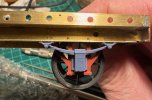
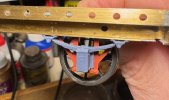
And a quick trial run of the axle boxes and springs - not fixed in place yet, so no need to worry about the off-centre spring.

IMG_6869.jpeg

IMG_6870.jpeg

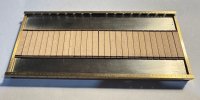
Because the final plank at each end has to slope up to meet the headstock, those are cut out separately, so they can be packed up 10thou or so and filed to a slope. Several end planks were cut of very slightly different widths, to allow the total length to be adjusted to be a perfect fit:

IMG_6864.jpeg

The laser cuts an approximately 0.3mm slit, just right for the 1/2" gap there should be between the planks. The material is 1mm basswood.

The dark strip down each side is where a groove about 0.2mm deep has been cut, to accommodate a nickel silver strip to represent the iron strip of the prototype.

The floor is in two parts, due to the material being too narrow to do it in one. Here are the parts roughly placed on the wagon, so you can see how it goes:

IMG_6865.jpeg

Nick.
 

magmouse

Western Thunderer
That spring / hanger / axle box assy shows 3DP at its finest!

Yup! Credit to Chris for that - drawn up in 3D from original drawings for the axle box and spring. Luckily the GA drawing for the Serpent is annotated with the spring type ("No. 105A"), and Chris happened to have a copy of the drawing for that type (noting that the camber is less than for general merchandise wagons of the same period).

Nick.
 

magmouse

Western Thunderer
They'd look even better if he had the leaf springs the right way round, you can see the indentation on the hanger to avoid the axleguard.... :cool:

Sorry, guv' - I wasn't issued with any instructions...

Actually, the Slaters axle guards being a fraction too wide, I'll need to file out the indentation a little bigger. Not a problem, now I know. Of course, I now realise I should be doing something to represent the top part of the rivet that attaches the spring shoe to the solebar. Good grief, does it ever end???

Nick.
 

simond

Western Thunderer
there has to be a joke about rivets and rattling and serpents and snakes, but honestly, I can't bring myself to try...
 

AJC

Western Thunderer
The springs look lovely. Not sure I'd notice the missing rivet, but the absence of the top flange of the solebar screams at me every time I open this thread. I suppose I ought to think about how I'd make a 4mm version...

Adam
 

magmouse

Western Thunderer
The springs look lovely. Not sure I'd notice the missing rivet, but the absence of the top flange of the solebar screams at me every time I open this thread. I suppose I ought to think about how I'd make a 4mm version...

Adam

The top flange is unlikely to be noticed in practice, given the size of the overhang, but in any case, fret not. I'm thinking of adding it, but not until the soldering is all done, as it will be easiest to do with a strip of 10 thou plasticard. One should also be able to see the edge of the floor plates, but given the sides are already too high, I'm ignoring that - the floor edge is just visible in some photos and not at all in others.

Nick.
 

magmouse

Western Thunderer
A bit more progress, adding details - these things always look like they ought to be done in an hour, but actually take far longer. Anyway, it's nice when you can get a wagon on its wheels, even if it's just the body plonked loosely on the axle guard units, as here:

IMG_6893.jpeg

IMG_6889.jpeg

IMG_6888.jpeg

I'm encouraged to see the model has the "low and wide" look of the prototype - the work getting the height as close as reasonably possible (within the constraints of the kit) to what it should be is paying off.

Perhaps not obvious in these photos is the amount that needed doing in the area where the solebars meet the headstocks - seen in this brutal close-up:

IMG_6890.jpeg

  • Square plate with 4 rivets, representing the corner bracket.
  • L-section tucked up under the body overhang. On the prototype it runs the full width, riveted to the inside of the headstock to support the end of the floor.
  • 2 pieces of 0.6mm wire soldered into the holes previously drilled in the headstocks to represent rivets.
  • A piece of square section brass soldered in and filed back to fill the gap in the solebar bottom flange. For some reason (or possibly no reason) the flanges stop too far short of the end of the solebar, and so don't meet the flange of the headstock.
Next step I think will be the ramps / floor extensions over the buffers.

Nick.
 
Top