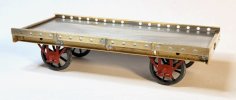
Well, the
fight taming continues...
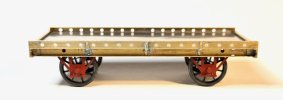
As mentioned in an earlier post, the prototype appears to use axle guards of a type intended for 3'7" wheels, thereby reducing the distance from axle centre to solebar. This in turn lowers the floor by an inch and a half, gaining a little height for the load.
I also mentioned that I had decided to use a set of etched axle guards from Slaters - originally intended I think for MR fitted vans, I think. As
@Overseer pointed out, these might not be quite right, and sure enough, a check against the drawing shows that the angled parts were at the wrong angle. So, I cut through the angled part at the bottom, parallel with the vertical, filed a bit off the end, bent it to a less steep angle, and soldered it back into place.
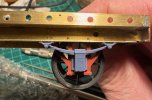
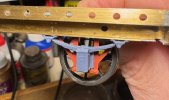
Here, on the right, the cut, and on the left, bent to the correct angle, ready for filing:

This comparison shows the difference - a noticeable and worthwhile change, I feel:
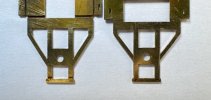
Once filed, the joint was soldered. The keeper also needed moving up, so these were cut off the etch and soldered back in the right place - seen here before and after cleaning up:
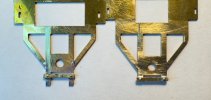
The next problem was that the Slaters units, if folded up as intended, would be too narrow. As well as the visual impact of this, it would mess up the relationship between solebar, axle guard , axle box and spring. I therefore decided to widen both the fixed and the rocking unit by cutting them up and soldering sections of brass angle to hold them together at the right width. The rocking unit had to be cut into three, to keep the slots for the attachment plate centred.

I will paint these before final assembly, and not attach them to the wagon until that is painted, so I don't have to worry about masking the wheels.
Having widened the axle guard units, I needed to pack out the bearings using 5BA washers:

Naturally, the amount needed wasn't an exact number of washers, so I made some half thickness ones by soldering them to a bit of spare fret and filing them thinner - you can see that in the picture above, where the left hand one of the three is half thickness.
A couple more pictures:

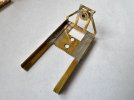
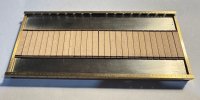
At this point I was feeling I had just spent several hours sorting out issues with both the kit itself, and the Slaters parts... The modelling gods then decided I was complaining too much about the shortcomings of other people's work, and perhaps too self satisfied about my own. They soon found a way of putting me in my place. You may recall I had added a new nickel silver floor on top of the kit sub floor. I had removed the axle guards from the sub floor, thinking this would make space for the new Slaters units to attach directly to the underside of my new floor.
Turns out - the Slaters units are too wide for the space left by the kit axle guards. After some wailing and gnashing of teeth, I considered my options:
1. fill the space with some packing, and attach the Slaters units to that, raising the height of the wagon by 0.5mm. Sounds innocuous, right? However, the distance from the centre of the axle to the underside of the solebar was already 8.5mm against a prototype equivalent to 7.875. Worse, the kit solebars are about 0.5mm too deep, and of course the floor is 0.5mm too thick. All these half millimetres were adding up - and a defining feature of the prototype is the way it is designed to maximise the available load height.
2. File some metal off the edges of the Slaters units - the amount needed wasn't much. The risk here was filing through the metal where the fold is, such that the strengthening ribs that run the width of the unit came away. Not a problem where I had already soldered the L section, but the side yet to be soldered has little metal to remove and still stay in one piece. I could of course file the corner off after final assembly, but at that point, there's a risk of damaging paintwork, and filling the bearings with brass filings. Possible, but unattractive...
3. Mill out the unwanted material of the sub floor. Sounds easy - two problems. One - I don't have a mill. Two, on inspection, it turned out the floor had taken on a slight curve across its width, higher in the middle (when the right way up). I have no idea how or when in the process that happened, but there it was. So - the option was to use a small mill bit on my Proton pillar drill, with the wagon attached to the X-Y table, thus making a crude mill. With no very accurate vertical control, the risk was cutting into the 8 thou nickel silver floor, and leaving a witness mark on the other side - this compounded by the curve in the floor.
Reviewing these options, I rejected (1) - if I was going to do that, I might as well build the kit as intended, and call it done. While the model will have compromises, I want to catch that 'like an ordinary wagon, but somehow a bit lower' character if I possibly can.
That left 2 and 3. I opted for 3, with 2 as a fall-back. After some anxious moments, I was able to carve out enough space for the fixed axleguard unit (the rocking one doesn't need the clearance:
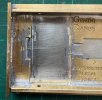
It is NOT pretty, and in one place there is the slightest of witness marks on the top face of the floor, but it will disappear with paint and dirt, I think. A useful reminder to me to think a bit harder before committing to soldering the top floor on - it would have been so simple to sort this issue while I could file the holes in the sub floor out bigger.
So, the beast is still fighting back, but step by step it is coming under control....
Nick.