SimonD’s workbench

simond

Western Thunderer
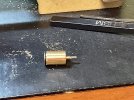
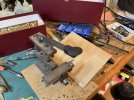
Here is the buffer problem. As you can see, the stem of the buffer extends beyond the cutaway in the frames. You may also see that the stem is a larger diameter than the major diameter of the thread, which is 10 BA / 1.6mm.
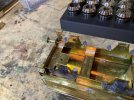
image.jpg

I therefore have to turn down the stem. I therefore have to hold it…. Given the shape, that’s a challenge.

The rather natty tray for the collets was printed on one of the work Bambu printers. Quite pleased with that. I shall do a similar tray for my BA taps & dies. And the metric ones when I get some more of them.

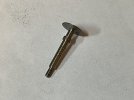
the brass round is 5/16” or a midge’s less than 8mm. I cleaned the outside and parted off a slice, which I then chucked, centre drilled, drilled 1.93mm and counter drilled 2.93, and then sawed through to make a split bush. This fits in the collet chuck nicely.

image.jpg

And it worked, though not without some very unexpected runout. And a significant difference in the buffer shank diameters, requiring the split collet to be opened up. Fortunately, by chance, I’d done the smaller one first.

Don’t understand the runout, and will have to investigate. Hopefully I managed to include some swarf in the collet chuck.

Not in the mood tonight however,

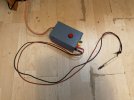
and to add to the snagging / to do list, I have the pickups, but I do not have a vac pipe and a steam heat hose. No worries, Kettering soon…
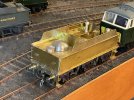

image.jpg

Simon
 

Attachments

  • image.jpg
    image.jpg
    318 KB · Views: 24
  • image.jpg
    image.jpg
    315.8 KB · Views: 18
  • image.jpg
    image.jpg
    250.2 KB · Views: 19

RichardG

Western Thunderer
I therefore have to turn down the stem. I therefore have to hold it…. Given the shape, that’s a challenge
If this was me, I would try to drill a hole through the stem to accept a steel pin. Then cut off the threaded part. If you can drill a suitable hole through the new collet, this would make a jig for drilling the stem.
 

simond

Western Thunderer
Hi Richard,

It would have required the same or very similar holding method in order to drill, as to turn down. The latter was just easier.

atb
Simon
 

Overseer

Western Thunderer
Don’t understand the runout, and will have to investigate.
If you are holding the split collet in an ER collet it is probably due to the split collet being shorter than the depth of the ER collet. ER collets only centre accurately when the material is gripped at both the front and rear of the ER collet. If not they distort and will not centre accurately. Probably better to hold the split collet in a three or four jaw chuck.
 

simond

Western Thunderer
If you are holding the split collet in an ER collet it is probably due to the split collet being shorter than the depth of the ER collet. ER collets only centre accurately when the material is gripped at both the front and rear of the ER collet. If not they distort and will not centre accurately. Probably better to hold the split collet in a three or four jaw chuck.
Thanks Fraser, that does make sense, my split collet is only 10.8 long, whereas the ER collets are around 32mm long.

interestingly, the smaller ER collets are counterbored at the back, which would be counter to your suggestion. Perhaps they will never work well. Amazon purchase at around two quid each….

I shall have to have a look, armed with some straight rod and a dti…

cheers
Simon
 

simond

Western Thunderer
Mmm, I wonder whether the limitations of 3DP and material flex would be kind to you.....

View attachment 256872

View attachment 256873

View attachment 256874

View attachment 256875
Thanks Tony.

I’m not going to say it can’t be done, but I think this would be extremely difficult in 7mm. The clearance between the turns is really fag papers (I guess they were made by coiling hot, around a former, and then scragging to get the longitudinal set) and the resin would bridge the gap between coils, so it would look ok, but be solid, thus not work, and I don’t think it would even in model engineering sizes, and anyway, it wouldn’t be strong enough at that sort of scale.

I’m sure it could be done by FDM at a large enough scale, but I think not 7mm, as 3/8” is 0.22mm and the smallest nozzles I’m aware of are 0.2, so it would not be able to build up, it could only extrude a single strand width. That, coupled with the natural surface roughness of FDM parts, suggests to me that it’s probably only feasible in 16mm & above. Watch someone prove me wrong :thumbs:
 

Overseer

Western Thunderer
Thanks Fraser, that does make sense, my split collet is only 10.8 long, whereas the ER collets are around 32mm long.

interestingly, the smaller ER collets are counterbored at the back, which would be counter to your suggestion. Perhaps they will never work well. Amazon purchase at around two quid each….

I shall have to have a look, armed with some straight rod and a dti…

cheers
Simon
The collets could be OK, the smaller sizes are bored to a larger diameter at the inner end presumably so they are flexible enough to act as a spring while being compressed. I was abbreviating a bit, the length of rod etc being held needs to be at least as long as the specified diameter parallel part of the collet.
 

Brian McKenzie

Western Thunderer
An issue with ER collet chucks is that the thread in the nuts is not always formed true to the taper within - and this influences the alignment of the collet and causes runout.
To counteract this, some industrial users recommend giving the tool a sharp rap in the appropriate direction.
I was skeptical at first, but now do this when necessary to gain some improvement (best done when the tool holder is not in the machine spindle).
 

Ian@StEnochs

Western Thunderer
Here is the buffer problem. As you can see, the stem of the buffer extends beyond the cutaway in the frames. You may also see that the stem is a larger diameter than the major diameter of the thread, which is 10 BA / 1.6mm.

View attachment 256850

I therefore have to turn down the stem. I therefore have to hold it…. Given the shape, that’s a challenge.

The rather natty tray for the collets was printed on one of the work Bambu printers. Quite pleased with that. I shall do a similar tray for my BA taps & dies. And the metric ones when I get some more of them.

the brass round is 5/16” or a midge’s less than 8mm. I cleaned the outside and parted off a slice, which I then chucked, centre drilled, drilled 1.93mm and counter drilled 2.93, and then sawed through to make a split bush. This fits in the collet chuck nicely.

View attachment 256856

And it worked, though not without some very unexpected runout. And a significant difference in the buffer shank diameters, requiring the split collet to be opened up. Fortunately, by chance, I’d done the smaller one first.

Don’t understand the runout, and will have to investigate. Hopefully I managed to include some swarf in the collet chuck.

Not in the mood tonight however,

and to add to the snagging / to do list, I have the pickups, but I do not have a vac pipe and a steam heat hose. No worries, Kettering soon…


View attachment 256870

Simon

Simon,

That’s a common problem where the tender frames are virtually in line with the buffer centres. As one seldom needs to take the buffers off once the model is painted I just file the ram shank down to D section and put a little bend in it to stop it popping out. Obviously you need enough clearance to get pliers in to grip the tail. I have a pair of thin jaw pliers which usually just squeezes in enough to grip.

Alternatively if there is no room, even with the back of the frame thinned down, one can solder a bit of wire onto the shank at right angles. A piece of paper jammed between frame holds the ram and ensures one doesn’t solder the buffer solid.

Your split collet hack is another good example of useful tooling and justification for the lathe user!

Ian.
 

simond

Western Thunderer
Hi Richard,

It would have required the same or very similar holding method in order to drill, as to turn down. The latter was just easier.

atb
Simon

Hi Richard,

Having seen Ian's post, I just re-read your post, and realised you probably meant a pin crossways - I was thinking of a co-axial pin, for no very good reason.

Yes, that would have been a solution, but I would still have had to hold the buffer. I could have used the split collet and held it in the dividing head on my milling machine, and cross drilled it there, and it would have been a simple and elegant solution.

6 and two threes...

Simon
 

simond

Western Thunderer
So, having pretty much built the tender, and done a wee bit of 3DP for the coal wagon project with @magmouse and some signally bits for @Jon Fitness this weekend, it’s time to hit the loco.

It’s a Warren Shepherd GW mogul kit and I have elected to build 4337, as that was a Birkenhead loco (I was BKD born, bred and buttered :thumbs: ) for much of its life, and most of my locos have some connection with the shed there. It’s rather important to sort out the number early on, as the moguls went through many changes and variants in their long and productive life. According to the David Andrews book, lots of them seem to have mileages of around 1.2 million at scrapping.

So, 4337, built 1913 under lot number 194. Diagram H. Initial shed Swindon, Birkenhead in 1922 and still there at Nationalisation. Withdrawn from Stourbridge in November 51, 1,165,987 miles.

Diagram H suggests the thin motion plate, longer cab, only two drain cocks per cylinder, chimney seems to have been copper-topped with capuchon. In my model era, it’s the early ‘30’s and 4337 got outside steam pipes in March 1932, presumably getting triple drain cocks with the new cylinders.

I haven’t found a photo of “my” loco but there are quite a few of locos in the same number range in the Andrews book and Russell vol 2 - fig 272 of the latter is loco 4339 which is the same lot, which is the closest I’ve found.

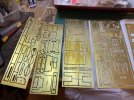
As is typical with Warren’s kits, you get your money’s worth in brass.

image.jpg

image.jpg

the frames and cross-members are etched on 0.7mm, and five other etches of 0.4 for the footplate, cabs and boiler.

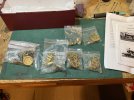
And lots and lots of lovely castings, some turnings and a few stampings.

image.jpg

Along with this little lot, I have Slaters wheels and Premier rods, and a Premier 30:1 two stage helical gearbox on a Canon 1833.

Now, I suppose I ought to read the instructions…
 
Last edited:

simond

Western Thunderer
It’s been a busy and somewhat stressful week, but I have done a little cutting out and cusp-filing.

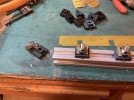
I also did a little 3DP

image.jpg

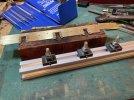
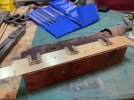
These little black blocks will, I hope, enable me fix the horns to the frames before assembling the frames.

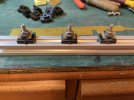
image.jpg

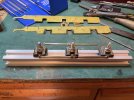
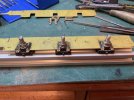
As you can see, the horns are a tight fit to the blocks, which themselves are aligned with dogs to the extruded channel, and which are spaced by the spigots, which are 2.5mm diameter to fit the coupling rods. I have to assemble the rods before doing much more.

The frames had half and full etched slots to enable them be cut out easily, but sadly they need to be 10.5mm wide rather than 8 to fit the horns. I shall mark and cut tomorrow.

all being well, I can then do this assembly on both frames (remembering to make a left and a right…) and with a bit of luck, it’ll roll freely first time. We shall see. Warts and all reporting on this channel!

in common with all Warren’s kits, there’s a fair bit of rivetting to do. I 3DP’d a knob for the rivetter handle too.

image.jpg

I shall upload the STP & STL files for the knob to the resources over the weekend. It saves bruised palms…

best
Simon
 

simond

Western Thunderer
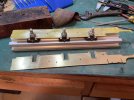
So, rods assembled, jig set. I didn’t leave quite enough clearance vertically to be able to have the rods on the spigots, whilst the hornguides are fitted to the guide blocks, but I could assemble them on both sides before tightening the M5 nuts & T-bolts which clamp the guide blocks on the extrusion. Should have printed them about 5mm taller.

I have just popped the rod on this side to double check that nothing has moved.

image.jpg

All in order :thumbs:

The frames were clamped together and I opened out the slots until they just fit snugly over the hornguides.

image.jpg

yup, as a bug in a rug.

Frames polished with emery cloth, joints fluxed, short lengths of 0.7mm flux-cored solder on each horn leg. Break out the RSU…

image.jpg

Home made back when Maplins still traded, probably 15 years back, but maybe more. Bought a “transformer kit” which comprised a set of E & I cores, a pre-wound primary and a plastic former on which to wind the secondary. The secondary is made from 3mm varnished copper wire and was calculated to give about 4 V on the highest range. It’s certainly only a few turns. It has some “grunt”. I operate the button with my big toe.

image.jpg

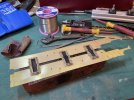
So far, so good. The jig has survived with the plastic parts intact, and the hornguides are attached to the left hand frame.

image.jpg

however…

image.jpg

this should be easily fixed. Wait for the next exciting installment!
 
Top